
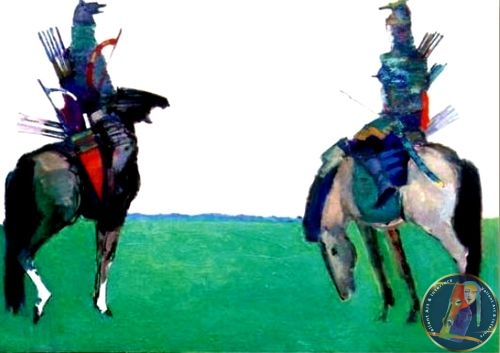
Ancestor

Enkhjin Tsultem , 2003 , Oil On Canvas

Ancestor is a poignant oil-on-canvas work by Enkhjin Tsultem that serves as a bridge between Mongolia’s nomadic heritage and the sophisticated techniques of European academic training. Measuring 99 x 128.5 cm, the painting utilizes its horizontal orientation to create a sense of vastness and temporal depth, characteristic of the artist’s “Abstract Modern” yet “Figurative” style.

Composition and Subject Matter

The painting is a masterclass in the figurative-abstract blend. While the title suggests a singular lineage, the visual representation often leans toward a monumental, almost sculptural presence.

  • The Central Figure: At the heart of the canvas is a stylized, weathered figure that feels carved from the Mongolian earth itself. Tsultem avoids hyper-realism, instead using broad, confident brushstrokes to suggest the rugged features of an elder or a primordial spirit.

  • The Palette: Reflecting his education in Dresden and Berlin, Tsultem employs a sophisticated, muted palette. Deep ochres, burnt sienna, and earthy umbers dominate the frame, punctuated by cool slate grays or fleeting hints of sky blue. This color scheme evokes the dusty, timeless atmosphere of the Steppe and the enduring nature of the “Ancestor.”

  • Texture and Form: The application of oil is thick and tactile. There is a “weathered” quality to the surface, mimicking the textures of ancient stone steles (Deer Stones) or the wind-beaten skin of a nomad.

Style and Influence

The painting demonstrates a unique synthesis of German Expressionism and Mongolian Traditionalism:

  • Structural Integrity: His time at the Hochschule fuer Bildende Kuenste is evident in the strong underlying structure of the composition. The figure isn’t just painted; it is built with architectural intent.

  • Nomadic Spirit: Despite the modern European technique, the “soul” of the piece is inherently Mongolian. The figure represents more than a person; it represents the collective memory, the “ancestor” of a nation that transitioned from a nomadic empire to a modern state.

  • Abstraction: The background often bleeds into the foreground, suggesting that the ancestor and the land are inseparable. This abstraction allows the viewer to project their own sense of history onto the canvas.

Thematic Significance

Created in 2003, during Tsultem’s mature period after serving as the Chairman of the Union of Mongolian Artists (UMA), Ancestor reflects a period of introspection. It is a quiet, powerful meditation on identity. By stripping away contemporary distractions, Tsultem focuses on the “Eternal Blue Sky” philosophy and the grounded nature of Mongolian lineage, presenting the ancestor as a guardian of the past and a foundation for the future.

  • Enkhjin Tsultem
  • Mongolian Style, Photorealism, Still Life
  • Oil On Canvas
  • ENK22/002
  • 99 x 128.5
  • Mongolian Art Gallery

Add Your Comment

Mongolian Art Gallery © 2025. All Rights Reserved
Privacy Policy / Terms of Use

Ancestor is a poignant oil-on-canvas work by Enkhjin Tsultem that serves as a bridge between Mongolia’s nomadic heritage and the sophisticated techniques of European academic training. Measuring 99 x 128.5 cm, the painting utilizes its horizontal orientation to create a sense of vastness and temporal depth, characteristic of the artist’s “Abstract Modern” yet “Figurative” style.

Composition and Subject Matter

The painting is a masterclass in the figurative-abstract blend. While the title suggests a singular lineage, the visual representation often leans toward a monumental, almost sculptural presence.

  • The Central Figure: At the heart of the canvas is a stylized, weathered figure that feels carved from the Mongolian earth itself. Tsultem avoids hyper-realism, instead using broad, confident brushstrokes to suggest the rugged features of an elder or a primordial spirit.

  • The Palette: Reflecting his education in Dresden and Berlin, Tsultem employs a sophisticated, muted palette. Deep ochres, burnt sienna, and earthy umbers dominate the frame, punctuated by cool slate grays or fleeting hints of sky blue. This color scheme evokes the dusty, timeless atmosphere of the Steppe and the enduring nature of the “Ancestor.”

  • Texture and Form: The application of oil is thick and tactile. There is a “weathered” quality to the surface, mimicking the textures of ancient stone steles (Deer Stones) or the wind-beaten skin of a nomad.

Style and Influence

The painting demonstrates a unique synthesis of German Expressionism and Mongolian Traditionalism:

  • Structural Integrity: His time at the Hochschule fuer Bildende Kuenste is evident in the strong underlying structure of the composition. The figure isn’t just painted; it is built with architectural intent.

  • Nomadic Spirit: Despite the modern European technique, the “soul” of the piece is inherently Mongolian. The figure represents more than a person; it represents the collective memory, the “ancestor” of a nation that transitioned from a nomadic empire to a modern state.

  • Abstraction: The background often bleeds into the foreground, suggesting that the ancestor and the land are inseparable. This abstraction allows the viewer to project their own sense of history onto the canvas.

Thematic Significance

Created in 2003, during Tsultem’s mature period after serving as the Chairman of the Union of Mongolian Artists (UMA), Ancestor reflects a period of introspection. It is a quiet, powerful meditation on identity. By stripping away contemporary distractions, Tsultem focuses on the “Eternal Blue Sky” philosophy and the grounded nature of Mongolian lineage, presenting the ancestor as a guardian of the past and a foundation for the future.