
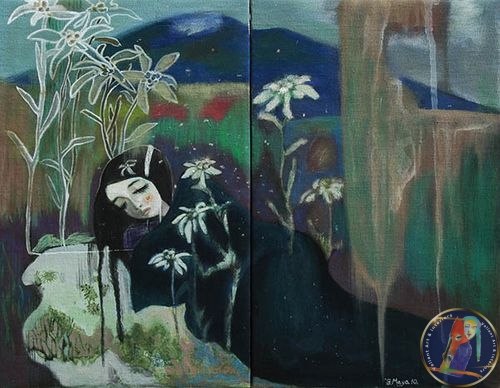
Yellow Face

Mydagmaa Tserenpil , 2007 , Oil On Canvas

Created during a pivotal period in Mydagmaa Tserenpil’s early career, Yellow Face is a compelling study in Minimalist Figurative expression. The work occupies a compact canvas, yet its emotional resonance is amplified by a bold, disciplined use of color and form that reflects the artist’s Mongolian heritage filtered through a modern lens.

Composition and Palette The painting is dominated by a luminous, saturated yellow that serves as both the subject and the atmosphere. Eschewing traditional realism, Tserenpil utilizes an abstracted approach to the human countenance. The “face” is not rendered through anatomical precision but through the strategic placement of minimalist lines and subtle tonal shifts. These features emerge from the golden background like a memory or a topographical map, echoing the vast, open horizons of the artist’s birthplace in Bayankhongor.

Technique and Style The application of oil paint is deliberate, with textures that suggest a quiet intensity. The brushwork oscillates between smooth, flat planes of color and more tactile, expressive marks that define the facial features. By stripping away extraneous detail, the artist invites the viewer into a meditative space where the subject becomes a universal symbol of identity rather than a specific portrait.

Artistic Context Though Tserenpil is often associated with landscape motifs, Yellow Face demonstrates her ability to apply the same spatial sensitivity and chromatic focus to the human form. The piece carries the sophisticated restraint that would later lead her work to international venues, such as the Art Shopping exhibition at the Carrousel Du Louvre in 2010.

Summary

Yellow Face is a testament to the power of color to convey complex internal states. It stands as a significant early example of contemporary Mongolian abstraction, capturing a delicate balance between the physical landscape of the steppes and the psychological landscape of the individual.
  • Mydagmaa Tserenpil
  • Abstract, Calligraphy
  • Oil On Canvas
  • MYD62/013
  • 27.5 x 38.5 cm
  • Mongolian Art Gallery

Add Your Comment

Mongolian Art Gallery © 2025. All Rights Reserved
Privacy Policy / Terms of Use

Created during a pivotal period in Mydagmaa Tserenpil’s early career, Yellow Face is a compelling study in Minimalist Figurative expression. The work occupies a compact canvas, yet its emotional resonance is amplified by a bold, disciplined use of color and form that reflects the artist’s Mongolian heritage filtered through a modern lens.

Composition and Palette The painting is dominated by a luminous, saturated yellow that serves as both the subject and the atmosphere. Eschewing traditional realism, Tserenpil utilizes an abstracted approach to the human countenance. The “face” is not rendered through anatomical precision but through the strategic placement of minimalist lines and subtle tonal shifts. These features emerge from the golden background like a memory or a topographical map, echoing the vast, open horizons of the artist’s birthplace in Bayankhongor.

Technique and Style The application of oil paint is deliberate, with textures that suggest a quiet intensity. The brushwork oscillates between smooth, flat planes of color and more tactile, expressive marks that define the facial features. By stripping away extraneous detail, the artist invites the viewer into a meditative space where the subject becomes a universal symbol of identity rather than a specific portrait.

Artistic Context Though Tserenpil is often associated with landscape motifs, Yellow Face demonstrates her ability to apply the same spatial sensitivity and chromatic focus to the human form. The piece carries the sophisticated restraint that would later lead her work to international venues, such as the Art Shopping exhibition at the Carrousel Du Louvre in 2010.

Summary

Yellow Face is a testament to the power of color to convey complex internal states. It stands as a significant early example of contemporary Mongolian abstraction, capturing a delicate balance between the physical landscape of the steppes and the psychological landscape of the individual.