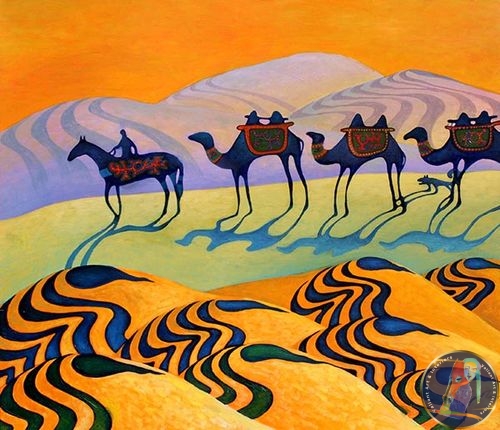
Yellow Caravan

Tsegmid Tserennadmid , 2008 , Oil On Canvas

Yellow Caravan is a striking oil-on-canvas work by the renowned Mongolian artist Tsegmid Tserennadmid. Measuring 60 x 73 cm, the painting is a masterful blend of Contemporary Expressionism and the vast, soul-stirring landscapes of the Mongolian steppe.

Composition and Subject Matter

The painting depicts a traditional caravan journey, a theme deeply rooted in Mongolian nomadic culture. However, Tserennadmid moves away from literal realism, opting instead for a semi-abstract interpretation. The “Yellow Caravan” of the title acts as the central rhythmic pulse of the piece. A line of figures and pack animals stretches across the canvas, rendered with fluid, energetic brushstrokes that suggest continuous movement through an infinite space.

Color Palette and Light

The work is dominated by a warm, radiant palette:

  • Golden Yellows and Ochres: These primary tones saturate the caravan, symbolizing the sun-drenched plains and perhaps a sense of preciousness or sacredness in the nomadic journey.

  • Deep Earth Tones: Rich siennas and burnt umbers provide a grounded contrast, defining the rugged terrain.

  • Ethereal Sky: The background often features a blend of soft pastels or stark, atmospheric hues that blur the line between the earth and the horizon, emphasizing the immense scale of the Mongolian wilderness.

Style and Technique

Reflecting Tserennadmid’s background in Expressionism and Modernism, the brushwork is bold and tactile. The artist uses thick, impasto-like applications of oil paint to create texture, giving the canvas a physical presence that mirrors the harsh yet beautiful Mongolian environment.

The figures in the caravan are not meticulously detailed; instead, they are captured as silhouettes of energy and endurance. This abstraction allows the viewer to focus on the feeling of the trek—the wind, the dust, and the rhythmic swaying of the animals—rather than a static moment in time.
  • Tsegmid Tserennadmid
  • Abstract, Modern/Contemporary
  • Oil On Canvas
  • TSG48/038
  • 60 x 73cm
  • Mongolian Art Gallery

Add Your Comment

Mongolian Art Gallery © 2025. All Rights Reserved
Privacy Policy / Terms of Use

Yellow Caravan is a striking oil-on-canvas work by the renowned Mongolian artist Tsegmid Tserennadmid. Measuring 60 x 73 cm, the painting is a masterful blend of Contemporary Expressionism and the vast, soul-stirring landscapes of the Mongolian steppe.

Composition and Subject Matter

The painting depicts a traditional caravan journey, a theme deeply rooted in Mongolian nomadic culture. However, Tserennadmid moves away from literal realism, opting instead for a semi-abstract interpretation. The “Yellow Caravan” of the title acts as the central rhythmic pulse of the piece. A line of figures and pack animals stretches across the canvas, rendered with fluid, energetic brushstrokes that suggest continuous movement through an infinite space.

Color Palette and Light

The work is dominated by a warm, radiant palette:

  • Golden Yellows and Ochres: These primary tones saturate the caravan, symbolizing the sun-drenched plains and perhaps a sense of preciousness or sacredness in the nomadic journey.

  • Deep Earth Tones: Rich siennas and burnt umbers provide a grounded contrast, defining the rugged terrain.

  • Ethereal Sky: The background often features a blend of soft pastels or stark, atmospheric hues that blur the line between the earth and the horizon, emphasizing the immense scale of the Mongolian wilderness.

Style and Technique

Reflecting Tserennadmid’s background in Expressionism and Modernism, the brushwork is bold and tactile. The artist uses thick, impasto-like applications of oil paint to create texture, giving the canvas a physical presence that mirrors the harsh yet beautiful Mongolian environment.

The figures in the caravan are not meticulously detailed; instead, they are captured as silhouettes of energy and endurance. This abstraction allows the viewer to focus on the feeling of the trek—the wind, the dust, and the rhythmic swaying of the animals—rather than a static moment in time.