Yellow Caravan 9

Tsegmid Tserennadmid , 2008 , Oil On Canvas

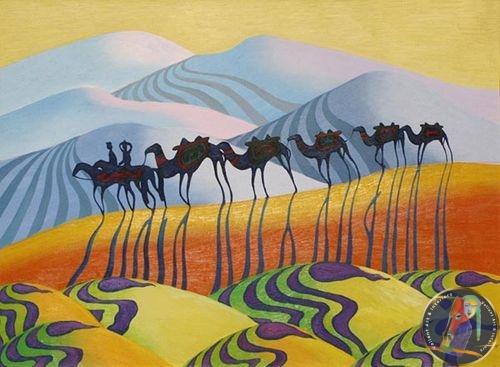
Yellow Caravan 9 is a compelling testament to Tsegmid Tserennadmid’s ability to fuse traditional Mongolian motifs with the bold, emotive language of modern expressionism. Painted in 2009, this oil-on-canvas work serves as a bridge between the ancient nomadic heritage of Central Asia and the fragmented, vibrant aesthetics of contemporary art.

Visual Composition and Style

The painting is characterized by a high-energy palette and a semi-abstract approach to landscape. While the title suggests a literal subject—a caravan—Tserennadmid deconstructs the scene into a rhythmic arrangement of shapes and colors.

  • The Palette: As the title implies, yellow dominates the canvas. It is not a static color but a vibrating force, ranging from deep ochre and sun-drenched gold to sharp lemon highlights. This yellow is contrasted against earthy browns, deep reds, and flashes of cool blues or greens, evoking the sun-scorched earth of the Mongolian steppe.

  • Form and Line: The “caravan” is rendered through expressive, gestural brushstrokes. Rather than detailed figures, the artist uses elongated forms and silhouettes to suggest movement. There is a sense of verticality in the brushwork that mimics the swaying motion of a journey across vast distances.

  • Texture: The oil paint is applied with varying degrees of thickness. In some areas, the impasto is heavy, creating a physical topography on the 60 x 73cm canvas that mirrors the rugged terrain of the artist’s homeland.

Thematic Context

Tserennadmid’s work often explores the concept of “movement” and “space”—central pillars of Mongolian identity. In Yellow Caravan 9, the “Caravan” is more than a mode of transport; it is a symbol of endurance and the eternal cycle of nomadic life.

By employing Expressionist and Abstract techniques, the artist moves away from the realism of the Socialist era that once dominated Mongolian art education. Instead, he captures the feeling of the heat, the dust, and the spiritual weight of the journey. The composition feels both expansive and claustrophobic, trapping the energy of the trek within the frame.


About the Artist: Tsegmid Tserennadmid

Tsegmid Tserennadmid (b. 1958) is a foundational figure in the Mongolian modern art movement. His career reflects a deep commitment to both his personal practice and the institutional development of art in Ulaanbaatar.

  • Educational Influence: Having served as the Director of the Art College and later the President of the University of Art & Culture in Ulaanbaatar, Tserennadmid has influenced generations of Mongolian artists. His transition from teacher to high-level administrator did not stifle his creativity; rather, it allowed him to champion the shift toward Contemporary and Modernist styles within the country.

  • Global Presence: By the time Yellow Caravan 9 was painted, Tserennadmid had established a significant international presence. His 2007 exhibitions in Montreal, Las Vegas, and London (specifically the Mongolian Kingdom of the Horse at Arndean Gallery) helped introduce the “Mongolian Modern” aesthetic to a global audience, showcasing a culture that is often stereotyped as purely traditional.
  • Tsegmid Tserennadmid
  • Abstract, Modern/Contemporary
  • Oil On Canvas
  • TSG48/039
  • 60 x 73cm
  • Mongolian Art Gallery

Add Your Comment

Mongolian Art Gallery © 2025. All Rights Reserved
Privacy Policy / Terms of Use

Yellow Caravan 9 is a compelling testament to Tsegmid Tserennadmid’s ability to fuse traditional Mongolian motifs with the bold, emotive language of modern expressionism. Painted in 2009, this oil-on-canvas work serves as a bridge between the ancient nomadic heritage of Central Asia and the fragmented, vibrant aesthetics of contemporary art.

Visual Composition and Style

The painting is characterized by a high-energy palette and a semi-abstract approach to landscape. While the title suggests a literal subject—a caravan—Tserennadmid deconstructs the scene into a rhythmic arrangement of shapes and colors.

  • The Palette: As the title implies, yellow dominates the canvas. It is not a static color but a vibrating force, ranging from deep ochre and sun-drenched gold to sharp lemon highlights. This yellow is contrasted against earthy browns, deep reds, and flashes of cool blues or greens, evoking the sun-scorched earth of the Mongolian steppe.

  • Form and Line: The “caravan” is rendered through expressive, gestural brushstrokes. Rather than detailed figures, the artist uses elongated forms and silhouettes to suggest movement. There is a sense of verticality in the brushwork that mimics the swaying motion of a journey across vast distances.

  • Texture: The oil paint is applied with varying degrees of thickness. In some areas, the impasto is heavy, creating a physical topography on the 60 x 73cm canvas that mirrors the rugged terrain of the artist’s homeland.

Thematic Context

Tserennadmid’s work often explores the concept of “movement” and “space”—central pillars of Mongolian identity. In Yellow Caravan 9, the “Caravan” is more than a mode of transport; it is a symbol of endurance and the eternal cycle of nomadic life.

By employing Expressionist and Abstract techniques, the artist moves away from the realism of the Socialist era that once dominated Mongolian art education. Instead, he captures the feeling of the heat, the dust, and the spiritual weight of the journey. The composition feels both expansive and claustrophobic, trapping the energy of the trek within the frame.


About the Artist: Tsegmid Tserennadmid

Tsegmid Tserennadmid (b. 1958) is a foundational figure in the Mongolian modern art movement. His career reflects a deep commitment to both his personal practice and the institutional development of art in Ulaanbaatar.

  • Educational Influence: Having served as the Director of the Art College and later the President of the University of Art & Culture in Ulaanbaatar, Tserennadmid has influenced generations of Mongolian artists. His transition from teacher to high-level administrator did not stifle his creativity; rather, it allowed him to champion the shift toward Contemporary and Modernist styles within the country.

  • Global Presence: By the time Yellow Caravan 9 was painted, Tserennadmid had established a significant international presence. His 2007 exhibitions in Montreal, Las Vegas, and London (specifically the Mongolian Kingdom of the Horse at Arndean Gallery) helped introduce the “Mongolian Modern” aesthetic to a global audience, showcasing a culture that is often stereotyped as purely traditional.