
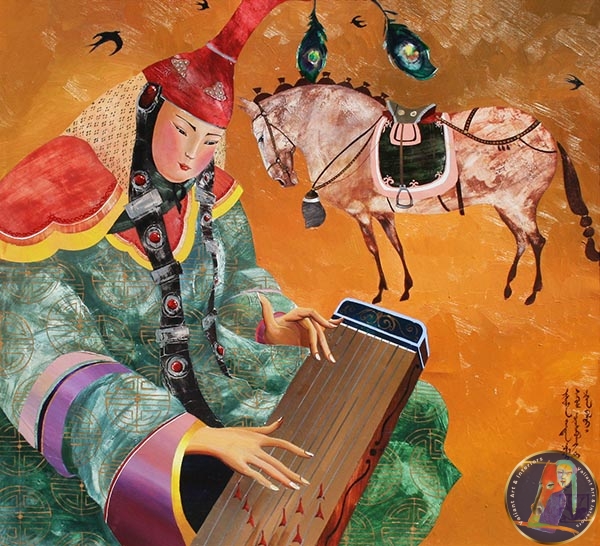
Yatga

Undram Enkhbold , 2009 , Oil On Canvas

Yatga is a compelling 65 x 70 cm oil on canvas painting that beautifully bridges classical Mongolian aesthetic traditions with a refined contemporary sensibility. The artwork centers on a single, elegant female figure absorbed in the act of playing the yatga—a traditional Mongolian plucked zither. The composition utilizes a warm, minimalist, parchment-like background that evokes the texture of historical silk paintings or aged paper, allowing the rich, saturated colors of the subject’s attire to command the viewer’s attention.

Detailed Formal Description

1. The Central Figure & Attire

  • Pose & Expression: The female musician is depicted sitting gracefully, tilted slightly forward over her instrument. Her expression is serene, introspective, and deeply focused, characterized by fine, minimalist lines defining her facial features in a manner reminiscent of traditional Mongol Zurag flat-rendered portraiture.

  • The Deel & Robes: She is enveloped in flowing, expansive robes that cascade onto the floor in stylized, undulating curves. The inner garment is a vibrant orange-terracotta hue, which creates a striking contrast against her outer robe. This outer layer is a deep, rich cerulean blue adorned with dark, stylized floral or starburst patterns. The hem of the blue robe is finished with an electric-blue border that twists dynamically along the ground, adding a sense of fluid movement to an otherwise still composition.

  • Headdress: The figure wears a tall, slender, traditional Mongolian headdress (toortsog or a stylized variant), colored in a warm burnt-sienna tone that tapers upward, finished with long, delicate, feather-like antennae or tassels arching elegantly into the upper-left negative space.

2. The Instrument (Yatga)

  • Placement & Detail: The wooden yatga cuts diagonally across the center of the canvas, resting securely across the figure’s lap. The artist treats the texture of the instrument with meticulous care, showcasing fine parallel lines that trace the grain of the wood and the alignment of the zither’s strings.

  • Interaction: The musician’s pale, elongated hands are placed delicately upon the strings—one near the upper bridge and the other mid-body—capturing a fleeting, silent moment of performance. A soft, stylized shadow stretches out horizontally from beneath the instrument across the neutral background, grounding it within the pictorial space.

3. Compositional Elements & Background

  • Background Treatment: The backdrop is rendered in a soft, textured wash of muted beige, ochre, and pale gold tones. It remains largely unornamented, focusing entirely on the harmony of line and color shape.

  • Traditional Calligraphy/Seal: In the upper-left quadrant, a prominent vertical inscription or artistic seal is rendered in dark ink, framed by a soft reddish-pink square. This element mirrors the placement of traditional seals and vertical Mongolian script, reinforcing the cultural heritage embedded in the modern piece.

  • Foliage: To the right of the musician, a slender, delicate branch with sparse green leaves curves gently upward, softening the edge of the frame and balancing the heavy diagonal of the instrument.

Style and Interpretation

Undram Enkhbold’s Yatga represents a masterclass in the synthesis of the old and the new. While the flat perspective, fine line work, and cultural subject matter directly reference historical Mongolian folk art, the bold handling of the oil medium, the specific choice of contrasting complementary colors (blue and orange), and the clean, spacious layout reflect a distinctly modern design sensibility. The painting captures not just a musician, but the quiet, enduring spirit of Mongolian musical heritage preserved in a contemporary gallery context.

  • Undram Enkhbold
  • Ulaanbaatar, Mongolia
  • Modern/Contemporary, Mongolian Style
  • Oil on canvas
  • UND/012
  • 65 x 70 cm25" x 27"
  • Valiant Art & Interiors

Add Your Comment

Mongolian Art Gallery © 2025. All Rights Reserved
Privacy Policy / Terms of Use

Yatga is a compelling 65 x 70 cm oil on canvas painting that beautifully bridges classical Mongolian aesthetic traditions with a refined contemporary sensibility. The artwork centers on a single, elegant female figure absorbed in the act of playing the yatga—a traditional Mongolian plucked zither. The composition utilizes a warm, minimalist, parchment-like background that evokes the texture of historical silk paintings or aged paper, allowing the rich, saturated colors of the subject’s attire to command the viewer’s attention.

Detailed Formal Description

1. The Central Figure & Attire

  • Pose & Expression: The female musician is depicted sitting gracefully, tilted slightly forward over her instrument. Her expression is serene, introspective, and deeply focused, characterized by fine, minimalist lines defining her facial features in a manner reminiscent of traditional Mongol Zurag flat-rendered portraiture.

  • The Deel & Robes: She is enveloped in flowing, expansive robes that cascade onto the floor in stylized, undulating curves. The inner garment is a vibrant orange-terracotta hue, which creates a striking contrast against her outer robe. This outer layer is a deep, rich cerulean blue adorned with dark, stylized floral or starburst patterns. The hem of the blue robe is finished with an electric-blue border that twists dynamically along the ground, adding a sense of fluid movement to an otherwise still composition.

  • Headdress: The figure wears a tall, slender, traditional Mongolian headdress (toortsog or a stylized variant), colored in a warm burnt-sienna tone that tapers upward, finished with long, delicate, feather-like antennae or tassels arching elegantly into the upper-left negative space.

2. The Instrument (Yatga)

  • Placement & Detail: The wooden yatga cuts diagonally across the center of the canvas, resting securely across the figure’s lap. The artist treats the texture of the instrument with meticulous care, showcasing fine parallel lines that trace the grain of the wood and the alignment of the zither’s strings.

  • Interaction: The musician’s pale, elongated hands are placed delicately upon the strings—one near the upper bridge and the other mid-body—capturing a fleeting, silent moment of performance. A soft, stylized shadow stretches out horizontally from beneath the instrument across the neutral background, grounding it within the pictorial space.

3. Compositional Elements & Background

  • Background Treatment: The backdrop is rendered in a soft, textured wash of muted beige, ochre, and pale gold tones. It remains largely unornamented, focusing entirely on the harmony of line and color shape.

  • Traditional Calligraphy/Seal: In the upper-left quadrant, a prominent vertical inscription or artistic seal is rendered in dark ink, framed by a soft reddish-pink square. This element mirrors the placement of traditional seals and vertical Mongolian script, reinforcing the cultural heritage embedded in the modern piece.

  • Foliage: To the right of the musician, a slender, delicate branch with sparse green leaves curves gently upward, softening the edge of the frame and balancing the heavy diagonal of the instrument.

Style and Interpretation

Undram Enkhbold’s Yatga represents a masterclass in the synthesis of the old and the new. While the flat perspective, fine line work, and cultural subject matter directly reference historical Mongolian folk art, the bold handling of the oil medium, the specific choice of contrasting complementary colors (blue and orange), and the clean, spacious layout reflect a distinctly modern design sensibility. The painting captures not just a musician, but the quiet, enduring spirit of Mongolian musical heritage preserved in a contemporary gallery context.