Working

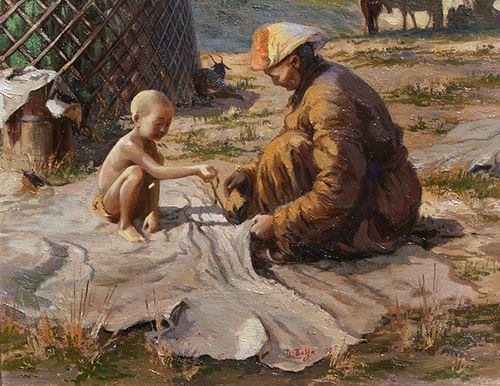
Batjargal Tseintsogzol , 2009 , Oil On Canvas

The painting captures a singular, focused moment of daily labor. Tseintsogzol often focused on the intersection of human activity and the vast Mongolian landscape. In Working, the artist likely depicts a scene central to the rural economy—perhaps the processing of wool, the preparation of livestock products, or the mending of essential tools.

The composition is intimate. By choosing a relatively small scale (40 x 50cm), the artist pulls the viewer close, mirroring the concentration of the subject. Every fold in the fabric of the worker’s “deel” (traditional Mongolian tunic) and every weathered line on their hands is rendered with a devotion to accuracy.

Style and Technique

Tseintsogzol was a virtuoso of Photorealism and Realism. In Working, these styles manifest through:

  • Texture: The artist excels at differentiating textures—the coarse grain of wooden tools, the softness of felt or textile, and the rugged, sun-beaten quality of skin.

  • Light and Shadow: Using a naturalistic light source, the painting likely features soft, directional light that creates deep, atmospheric shadows. This adds a sense of three-dimensional volume and weight to the figure.

  • Color Palette: Expect a grounded, earthy palette. Ochers, deep browns, and muted blues or reds (typical of Mongolian textiles) dominate the frame, harmonizing the human subject with the natural world.

Thematic Depth: Nature and Labor

Though the painting is titled Working, it is as much about Nature as it is about the task at hand. In the Mongolian tradition, labor is not seen as an extraction from nature, but a dance with it.

  • The Nomad’s Spirit: The painting immortalizes the “unseen” work that sustains a culture.

  • Stillness in Motion: There is a paradoxical sense of quietude. Even though the subject is “working,” the realism conveys a meditative state, suggesting that labor is a form of presence.

Artist Context: Batjargal Tseintsogzol (1966–2020) was a pivotal figure in Ulaanbaatar’s art scene. His work is celebrated for capturing the “soul” of Mongolia without resorting to romanticized stereotypes, relying instead on the raw, honest beauty of the everyday.
  • Batjargal Tseintsogzol
  • Realism, Still Life
  • Oil On Canvas
  • BTJ8/106
  • 40 x 50cm
  • Mongolian Art Gallery

Add Your Comment

Mongolian Art Gallery © 2025. All Rights Reserved
Privacy Policy / Terms of Use

The painting captures a singular, focused moment of daily labor. Tseintsogzol often focused on the intersection of human activity and the vast Mongolian landscape. In Working, the artist likely depicts a scene central to the rural economy—perhaps the processing of wool, the preparation of livestock products, or the mending of essential tools.

The composition is intimate. By choosing a relatively small scale (40 x 50cm), the artist pulls the viewer close, mirroring the concentration of the subject. Every fold in the fabric of the worker’s “deel” (traditional Mongolian tunic) and every weathered line on their hands is rendered with a devotion to accuracy.

Style and Technique

Tseintsogzol was a virtuoso of Photorealism and Realism. In Working, these styles manifest through:

  • Texture: The artist excels at differentiating textures—the coarse grain of wooden tools, the softness of felt or textile, and the rugged, sun-beaten quality of skin.

  • Light and Shadow: Using a naturalistic light source, the painting likely features soft, directional light that creates deep, atmospheric shadows. This adds a sense of three-dimensional volume and weight to the figure.

  • Color Palette: Expect a grounded, earthy palette. Ochers, deep browns, and muted blues or reds (typical of Mongolian textiles) dominate the frame, harmonizing the human subject with the natural world.

Thematic Depth: Nature and Labor

Though the painting is titled Working, it is as much about Nature as it is about the task at hand. In the Mongolian tradition, labor is not seen as an extraction from nature, but a dance with it.

  • The Nomad’s Spirit: The painting immortalizes the “unseen” work that sustains a culture.

  • Stillness in Motion: There is a paradoxical sense of quietude. Even though the subject is “working,” the realism conveys a meditative state, suggesting that labor is a form of presence.

Artist Context: Batjargal Tseintsogzol (1966–2020) was a pivotal figure in Ulaanbaatar’s art scene. His work is celebrated for capturing the “soul” of Mongolia without resorting to romanticized stereotypes, relying instead on the raw, honest beauty of the everyday.