Woman With Baby Cow

Munkhjin Tsultem , 2003 , Oil On Canvas

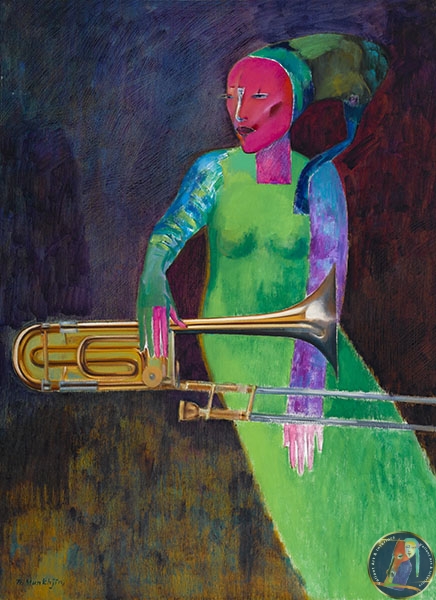
In this striking figurative work, Munkhjin Tsultem captures a moment of profound, quiet intimacy between a Mongolian woman and a young calf. The composition is vertically oriented, utilizing the 130 x 97 cm canvas to create a monumental presence for the figures.

The woman is the central focal point, rendered with the technical precision reflective of Tsultem’s training at the Stroganoff Institute. She is depicted in traditional Mongolian attire, though the style leans toward a modern, stylized interpretation. Her expression is one of serene contemplation, embodying a deep, ancestral connection to the livestock that sustains nomadic life.

Cradled in her arms—or standing in close proximity—is a baby cow. The animal is rendered with soft, empathetic brushwork, emphasizing its vulnerability and the protective nature of the woman’s stance.


Style and Technique

Tsultem fuses his Moscow-based academic roots with the soul of Mongolian Contemporary art.

  • Color Palette: The artist typically employs rich, earthy tones—ochres, deep reds, and celestial blues—balanced by the natural, muted hues of the calf’s hide.

  • Form: While the figures are clearly defined (Figurative style), there is a rhythmic quality to the lines of the woman’s clothing and the anatomy of the calf, suggesting a blend of realism and symbolic abstraction.

  • Lighting: The light source is often soft and diffused, highlighting the texture of the oil paint and creating a sense of timelessness, as if the scene exists outside of a specific hour or era.


Thematic Context

Created in 2003, Woman With Baby Cow serves as a bridge between the traditional Mongolian way of life and the evolving identity of a post-socialist nation.

The painting explores the maternal bond, extending it beyond the human realm to the animal kingdom. It reflects the Mongolian philosophy of coexistence, where the survival of the herder and the herd are inextricably linked. The large scale of the canvas elevates this simple pastoral interaction to the level of high art, demanding that the viewer acknowledge the dignity and spiritual weight of rural Mongolian life.
  • Munkhjin Tsultem
  • Figurative, Geometric
  • Oil On Canvas
  • MUN35/008
  • 130 x 97cm
  • Mongolian Art Gallery

Add Your Comment

Mongolian Art Gallery © 2025. All Rights Reserved
Privacy Policy / Terms of Use

In this striking figurative work, Munkhjin Tsultem captures a moment of profound, quiet intimacy between a Mongolian woman and a young calf. The composition is vertically oriented, utilizing the 130 x 97 cm canvas to create a monumental presence for the figures.

The woman is the central focal point, rendered with the technical precision reflective of Tsultem’s training at the Stroganoff Institute. She is depicted in traditional Mongolian attire, though the style leans toward a modern, stylized interpretation. Her expression is one of serene contemplation, embodying a deep, ancestral connection to the livestock that sustains nomadic life.

Cradled in her arms—or standing in close proximity—is a baby cow. The animal is rendered with soft, empathetic brushwork, emphasizing its vulnerability and the protective nature of the woman’s stance.


Style and Technique

Tsultem fuses his Moscow-based academic roots with the soul of Mongolian Contemporary art.

  • Color Palette: The artist typically employs rich, earthy tones—ochres, deep reds, and celestial blues—balanced by the natural, muted hues of the calf’s hide.

  • Form: While the figures are clearly defined (Figurative style), there is a rhythmic quality to the lines of the woman’s clothing and the anatomy of the calf, suggesting a blend of realism and symbolic abstraction.

  • Lighting: The light source is often soft and diffused, highlighting the texture of the oil paint and creating a sense of timelessness, as if the scene exists outside of a specific hour or era.


Thematic Context

Created in 2003, Woman With Baby Cow serves as a bridge between the traditional Mongolian way of life and the evolving identity of a post-socialist nation.

The painting explores the maternal bond, extending it beyond the human realm to the animal kingdom. It reflects the Mongolian philosophy of coexistence, where the survival of the herder and the herd are inextricably linked. The large scale of the canvas elevates this simple pastoral interaction to the level of high art, demanding that the viewer acknowledge the dignity and spiritual weight of rural Mongolian life.