

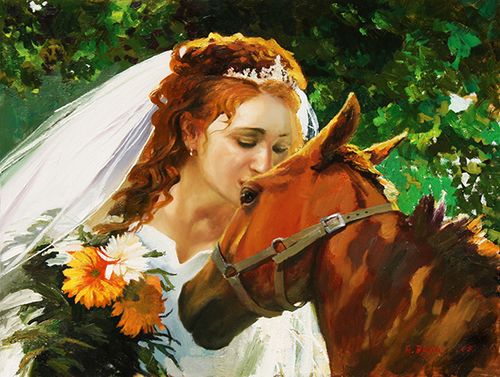
This 2008 oil on canvas by the late Mongolian master Batjargal Tseintsogzol (1966–2020) is a profound testament to the artist’s mastery of Photorealism and his deep-seated connection to the nomadic spirit of his homeland. Measuring 50 x 60 cm, the work offers an intimate, almost cinematic glimpse into the quietude of Mongolian life.
Visual Composition and Style
The painting is characterized by a breathtaking level of detail that blurs the line between paint and photography. Tseintsogzol utilizes a Realist approach to capture the physical textures of the scene with hyper-accuracy:
The Subjects: The central focus is the symbiotic relationship between the woman and the horse. Her attire—likely a traditional deel—is rendered with such precision that one can almost feel the weight and weave of the fabric.
The Equine Form: The horse is not merely a background element; it is a co-protagonist. Tseintsogzol captures the velvet-like texture of its coat, the moisture in its eye, and the subtle muscular tension in its neck, showcasing his expertise in Nature and animal anatomy.
Lighting and Atmosphere: The artist employs soft, naturalistic lighting that suggests the golden hour of the Mongolian steppe. This light creates a gentle interplay of shadows, adding a three-dimensional depth that pulls the viewer into the frame.
Symbolic Resonance
Beyond the technical brilliance of the Photorealism, Woman and Horse serves as a cultural bridge. In Mongolian tradition, the horse is a symbol of vitality and freedom, while the woman represents the hearth and the endurance of the nomadic lifestyle.
Quiet Intimacy: There is no grand action or dramatic movement. Instead, the painting captures a “stilled moment,” emphasizing the unspoken communication and mutual trust between human and animal.
The Steppe Aesthetic: The background, though often rendered with soft-focus (bokeh) effects in Tseintsogzol’s work to emphasize the foreground, conveys the vastness and serenity of the Mongolian landscape.
About the Artist: Batjargal Tseintsogzol
Born in Ulaanbaatar, Tseintsogzol became a pivotal figure in modern Mongolian art. His work is celebrated for its ability to elevate everyday rural scenes into monumental displays of technical skill. His untimely passing in 2020 left a void in the contemporary Realism scene, but works like Woman and Horse remain as definitive examples of his legacy—capturing the soul of Mongolia with a brushstroke so fine it appears invisible.
Note: The dimensions (50 x 60 cm) suggest a “cabinet painting” scale, designed for close-up viewing where the viewer can truly appreciate the microscopic details of the oil application.
