
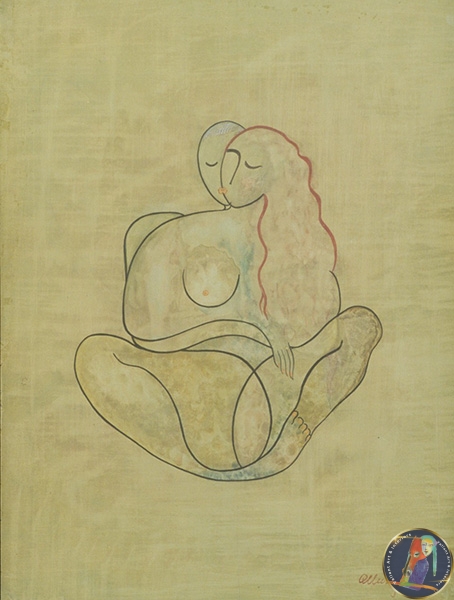
Woman 4

Mica Onon , 2005 , Paint On Silk

Woman 4 is an intimate and delicate exploration of the female figure, rendered with the ethereal transparency characteristic of traditional silk painting. The composition centers on a singular feminine form, where the artist utilizes the fine grain of the silk substrate to create a soft, luminous quality. The lines are fluid and rhythmic, suggesting a mastery of both Mongolian sculptural sensibilities and the refined techniques of San Francisco’s fine art tradition.

The figure is depicted with a sense of stillness and introspection. Rather than focusing on heavy anatomical realism, the artist emphasizes the interplay of light and shadow through translucent layers of pigment. The application of color is subtle, allowing the natural luster of the silk to act as a mid-tone, which imbues the subject with an organic, breathing vitality.

Style and Technique

The work bridges the gap between traditional Thangka influences—evident in the precision of the line work—and a contemporary Western approach to figurative abstraction. There is a perceptible “sculptural” weight to the silhouette, likely a reflection of the artist’s background in three-dimensional form, yet it is executed with a lightness that feels almost fleeting.

The 2005 creation date marks a pivotal moment in the artist’s career, coinciding with the completion of advanced fine art studies in the United States. This influence is seen in the sophisticated use of negative space; the area surrounding the woman is not merely empty but serves to compress the viewer’s focus onto the emotional posture of the subject.

Narrative and Atmosphere

The atmosphere of the painting is one of quietude and heritage. There is a profound sense of “inner space,” suggesting a narrative of transition or memory. The small, horizontal format (20 x 30 cm) invites a close-up, personal viewing experience, echoing the meticulous detail found in historic Mongolian miniatures while speaking a modern, universal language of feminine identity. The result is a portrait that feels both ancient and immediate, grounded in the discipline of Buddhist art history but expressed through a contemporary lens.
  • Mica Onon
  • Figurative, Photorealism
  • Paint On Silk
  • MO03
  • 20 x 30cm
  • Mongolian Art Gallery

Add Your Comment

Mongolian Art Gallery © 2025. All Rights Reserved
Privacy Policy / Terms of Use

Woman 4 is an intimate and delicate exploration of the female figure, rendered with the ethereal transparency characteristic of traditional silk painting. The composition centers on a singular feminine form, where the artist utilizes the fine grain of the silk substrate to create a soft, luminous quality. The lines are fluid and rhythmic, suggesting a mastery of both Mongolian sculptural sensibilities and the refined techniques of San Francisco’s fine art tradition.

The figure is depicted with a sense of stillness and introspection. Rather than focusing on heavy anatomical realism, the artist emphasizes the interplay of light and shadow through translucent layers of pigment. The application of color is subtle, allowing the natural luster of the silk to act as a mid-tone, which imbues the subject with an organic, breathing vitality.

Style and Technique

The work bridges the gap between traditional Thangka influences—evident in the precision of the line work—and a contemporary Western approach to figurative abstraction. There is a perceptible “sculptural” weight to the silhouette, likely a reflection of the artist’s background in three-dimensional form, yet it is executed with a lightness that feels almost fleeting.

The 2005 creation date marks a pivotal moment in the artist’s career, coinciding with the completion of advanced fine art studies in the United States. This influence is seen in the sophisticated use of negative space; the area surrounding the woman is not merely empty but serves to compress the viewer’s focus onto the emotional posture of the subject.

Narrative and Atmosphere

The atmosphere of the painting is one of quietude and heritage. There is a profound sense of “inner space,” suggesting a narrative of transition or memory. The small, horizontal format (20 x 30 cm) invites a close-up, personal viewing experience, echoing the meticulous detail found in historic Mongolian miniatures while speaking a modern, universal language of feminine identity. The result is a portrait that feels both ancient and immediate, grounded in the discipline of Buddhist art history but expressed through a contemporary lens.