
Winter Hometown

Ulziijavkhlan Adyabaatar , 2008 , Oil On Canvas

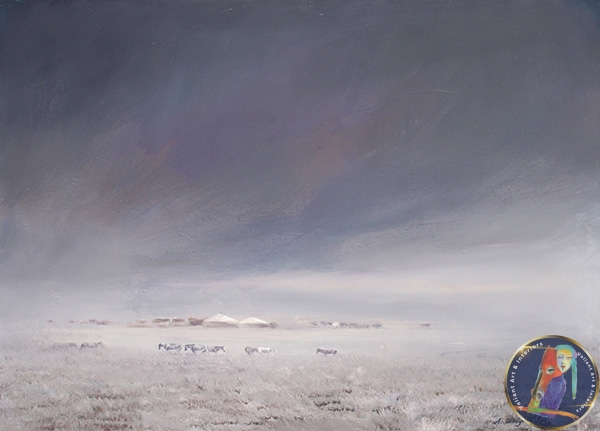
Winter Hometown is a figurative realist landscape depicting a traditional winter settlement (ovoljoo) in the rural Mongolian steppe. The composition utilizes a wide, expansive horizon typical of Adyabaatar’s work, emphasizing the vastness of the landscape relative to human habitation.

The focal point features a cluster of gers (traditional felt tents) nestled against a low backdrop of rolling hills. The placement of the homestead suggests a carefully chosen shelter against the harsh elements of the Gobi winter. Patches of livestock, likely sheep or goats, are visible near the enclosures, captured with soft, textural brushstrokes to indicate the community’s reliance on nomadic pastoralism.

Color Palette & Light

The canvas is dominated by an evocative, muted winter palette. Adyabaatar uses a complex gradient of whites, soft greys, and pale blues to render the thick blanket of snow covering the plains. Rather than a stark, cold white, the snow reflects the atmospheric conditions of the day—infused with faint tones of lavender, cream, and ochre where the winter sun grazes the landscape.

The sky is vast, filling the upper portion of the frame with a pale, hazy light that suggests a crisp, sub-zero afternoon. Shadows are long and cast in cool tones, adding depth to the drifts of snow and defining the contours of the distant hills.

Technique & Style

The painting is rendered in a realistic style with visible, expressive brushwork that gives texture to the felt of the gers, the rough terrain underneath the melting edges of snow, and the distant, hazy atmosphere. The artist avoids clinical precision in favor of a soft, organic realism that conveys a profound sense of tranquility, isolation, and domestic warmth amid a frozen environment.

Artistic Interpretation

In keeping with Adyabaatar’s dedication to “eco-art,” Winter Hometown serves as a visual testament to the resilience of nomadic Mongolian life. By framing the small human settlement within an immense, indifferent winter landscape, the artwork conveys a sense of harmony rather than conflict. The home is not conquering the wilderness; it is safely woven into its seasonal rhythms, capturing what the artist frequently describes as the “great peacefulness” of traditional Mongolian life.
  • Ulziijavkhlan Adyabaatar
  • Dund Gobi, Mongolia
  • Figurative, Landscape, Nature, Portrait, Realism
  • Oil on canvas
  • ULZ83/011
  • 60 x 72cm23" x 28"
  • Valiant Art & Interiors

Add Your Comment

Mongolian Art Gallery © 2025. All Rights Reserved
Privacy Policy / Terms of Use

Winter Hometown is a figurative realist landscape depicting a traditional winter settlement (ovoljoo) in the rural Mongolian steppe. The composition utilizes a wide, expansive horizon typical of Adyabaatar’s work, emphasizing the vastness of the landscape relative to human habitation.

The focal point features a cluster of gers (traditional felt tents) nestled against a low backdrop of rolling hills. The placement of the homestead suggests a carefully chosen shelter against the harsh elements of the Gobi winter. Patches of livestock, likely sheep or goats, are visible near the enclosures, captured with soft, textural brushstrokes to indicate the community’s reliance on nomadic pastoralism.

Color Palette & Light

The canvas is dominated by an evocative, muted winter palette. Adyabaatar uses a complex gradient of whites, soft greys, and pale blues to render the thick blanket of snow covering the plains. Rather than a stark, cold white, the snow reflects the atmospheric conditions of the day—infused with faint tones of lavender, cream, and ochre where the winter sun grazes the landscape.

The sky is vast, filling the upper portion of the frame with a pale, hazy light that suggests a crisp, sub-zero afternoon. Shadows are long and cast in cool tones, adding depth to the drifts of snow and defining the contours of the distant hills.

Technique & Style

The painting is rendered in a realistic style with visible, expressive brushwork that gives texture to the felt of the gers, the rough terrain underneath the melting edges of snow, and the distant, hazy atmosphere. The artist avoids clinical precision in favor of a soft, organic realism that conveys a profound sense of tranquility, isolation, and domestic warmth amid a frozen environment.

Artistic Interpretation

In keeping with Adyabaatar’s dedication to “eco-art,” Winter Hometown serves as a visual testament to the resilience of nomadic Mongolian life. By framing the small human settlement within an immense, indifferent winter landscape, the artwork conveys a sense of harmony rather than conflict. The home is not conquering the wilderness; it is safely woven into its seasonal rhythms, capturing what the artist frequently describes as the “great peacefulness” of traditional Mongolian life.