Winter Caravan 3

Tsegmid Tserennadmid , 2007 , Oil On Canvas

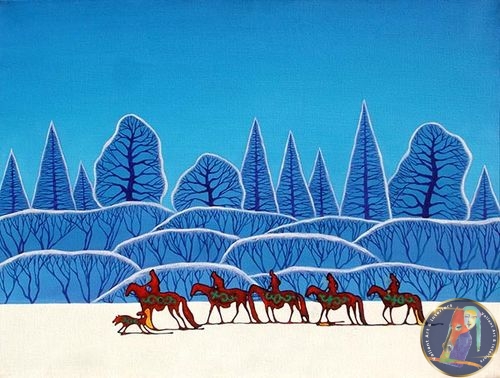
Winter Caravan 3 is a compelling synthesis of Mongolian nomadic heritage and contemporary expressionism. Created during a peak year in Tserennadmid’s international career, the work captures the atmospheric intensity of the Mongolian steppe during the harshest season.

Composition and Subject Matter

The painting depicts a traditional caravan—likely camels or horses—navigating a vast, frozen expanse. Rather than a photorealistic depiction, Tserennadmid utilizes an Expressionist approach, where the subjects are rendered with bold, sweeping gestures. The “caravan” appears as a rhythmic progression of dark, heavy shapes that seem to struggle against a pervasive, biting wind. The 60 x 80 cm format provides a cinematic width, emphasizing the horizontal journey across an infinite, unforgiving horizon.

Color Palette and Light

The palette is dominated by the cool, stark tones of winter. High-contrast whites and icy blues form the foundation of the snow-covered earth and the heavy sky, effectively blurring the line between the ground and the atmosphere. Tserennadmid breaks this cold monotony with “earth-memory” tones—deep umbers, charcoal blacks, and perhaps hints of ochre—representing the physical bodies of the animals and their gear. The light in the painting is diffused and ethereal, suggesting the low, pale sun of a Mongolian winter afternoon.

Technique and Style

Drawing from his background in Modernism and Abstraction, the artist employs thick, textural brushwork. There is a sense of “action painting” in the sky and foreground; the oil paint is applied with an urgency that mimics the swirling movement of snow and dust. The figures of the caravan are not finely detailed; instead, they are evocative silhouettes that prioritize the feeling of movement and endurance over anatomical precision.

Cultural Context

As a former President of the University of Art & Culture in Ulaanbaatar, Tserennadmid’s work is deeply intellectual. Winter Caravan 3 acts as a bridge between the ancient Mongolian way of life and the modern world. The painting does not just show a journey; it serves as a metaphor for the resilience of the Mongolian spirit. The abstraction of the landscape reflects the “emptiness” (the Gobi or the Steppe) that is central to the nation’s spatial identity.
  • Tsegmid Tserennadmid
  • Abstract, Modern/Contemporary
  • Oil On Canvas
  • TSG48/015
  • 60 x 80cm
  • Mongolian Art Gallery

Add Your Comment

Mongolian Art Gallery © 2025. All Rights Reserved
Privacy Policy / Terms of Use

Winter Caravan 3 is a compelling synthesis of Mongolian nomadic heritage and contemporary expressionism. Created during a peak year in Tserennadmid’s international career, the work captures the atmospheric intensity of the Mongolian steppe during the harshest season.

Composition and Subject Matter

The painting depicts a traditional caravan—likely camels or horses—navigating a vast, frozen expanse. Rather than a photorealistic depiction, Tserennadmid utilizes an Expressionist approach, where the subjects are rendered with bold, sweeping gestures. The “caravan” appears as a rhythmic progression of dark, heavy shapes that seem to struggle against a pervasive, biting wind. The 60 x 80 cm format provides a cinematic width, emphasizing the horizontal journey across an infinite, unforgiving horizon.

Color Palette and Light

The palette is dominated by the cool, stark tones of winter. High-contrast whites and icy blues form the foundation of the snow-covered earth and the heavy sky, effectively blurring the line between the ground and the atmosphere. Tserennadmid breaks this cold monotony with “earth-memory” tones—deep umbers, charcoal blacks, and perhaps hints of ochre—representing the physical bodies of the animals and their gear. The light in the painting is diffused and ethereal, suggesting the low, pale sun of a Mongolian winter afternoon.

Technique and Style

Drawing from his background in Modernism and Abstraction, the artist employs thick, textural brushwork. There is a sense of “action painting” in the sky and foreground; the oil paint is applied with an urgency that mimics the swirling movement of snow and dust. The figures of the caravan are not finely detailed; instead, they are evocative silhouettes that prioritize the feeling of movement and endurance over anatomical precision.

Cultural Context

As a former President of the University of Art & Culture in Ulaanbaatar, Tserennadmid’s work is deeply intellectual. Winter Caravan 3 acts as a bridge between the ancient Mongolian way of life and the modern world. The painting does not just show a journey; it serves as a metaphor for the resilience of the Mongolian spirit. The abstraction of the landscape reflects the “emptiness” (the Gobi or the Steppe) that is central to the nation’s spatial identity.