

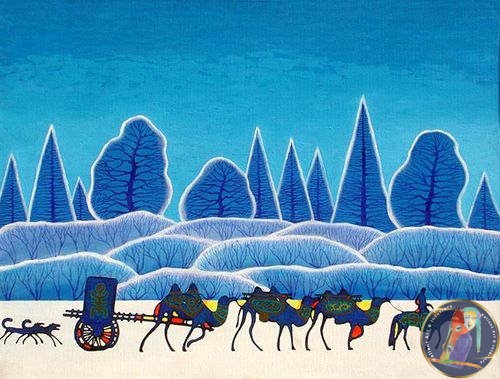
Winter Caravan 2 is a compelling exploration of movement and survival within the harsh, expansive Mongolian landscape. True to Tsegmid Tserennadmid’s signature blend of Expressionism and Contemporary Abstraction, the painting captures a nomadic caravan pushing through a frigid environment.
Composition and Subject: The work depicts a line of figures—likely camels and riders—rendered with rhythmic, gestural brushstrokes that suggest a slow, determined pace. Rather than focusing on anatomical precision, Tsegmid uses the forms of the caravan to create a silhouette that anchors the vastness of the canvas. The horizontal orientation of the 60 x 80 cm canvas emphasizes the endlessness of the steppe.
Color Palette and Atmosphere: The palette is dominated by “cold” tones: fractured whites, icy blues, and muted greys that represent the biting winter air and snow-covered ground. These are contrasted by deep, earthy ochres or dark umbers used for the caravan itself, providing a visual “weight” to the living subjects against the ethereal, almost translucent background.
Style and Technique: The influence of Modernism is evident in the artist’s use of space; the sky and earth often bleed into one another, suggesting a blinding blizzard or the hazy light of a winter sun. The texture of the oil paint is likely applied with both brushes and palette knives, creating a physical ruggedness on the canvas that mirrors the grit required for nomadic life.
Contextual Background
Created in 2007, this piece represents a mature period for Tsegmid, following his high-profile academic career as the Director of the Art College and President of the University of Art & Culture in Ulaanbaatar.
That same year, his work gained significant international exposure, appearing in major North American and European exhibitions:
Expo Art 2007 (Montreal, Canada)
Art Expo 2007 (Las Vegas, USA)
Mongolian Kingdom of the Horse (Arndean Gallery, London)
Winter Caravan 2 stands as a testament to Tsegmid’s ability to take a traditional Mongolian motif—the caravan—and elevate it into a universal expression of endurance through a modern, abstract lens.
