
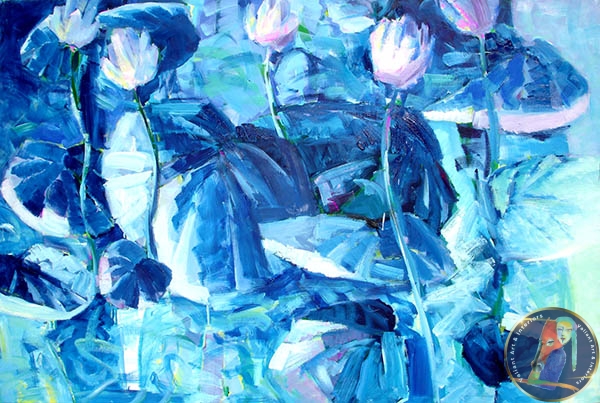
Usan Deerh Tsetsges is an evocative, mid-career oil painting by Mongolian contemporary artist Uranchimeg Sodnom. Painted in a wide, horizontal landscape layout (80 x 120 cm), the composition centers around a fluid, organic theme heavily steeped in nature, color theory, and Post-Socialist Mongolian modernism.
Subject Matter & Imagery
True to its translated title, “Flowers on the Water,” the primary visual focus of the canvas is an abstract or semi-abstract depiction of floral elements interacting with a liquid surface. Rather than a stark, traditional landscape, Sodnom utilizes her background in both pedagogical illustration and fine art to blend sharp observation with highly symbolic form. The “flowers” emerge not strictly as botanically accurate specimens, but as bursts of organic shapes, floating, reflecting, or partially submerged within a vast expanse of water.
Given Sodnom’s broader portfolio during this period (which frequently explores themes of femininity, nature, and raw human emotion, as seen in concurrent works like Red Woman and Naked Girls), the flowers on the water serve as a powerful metaphor for resilience, fluid identity, and grace.
Color Palette & Light
The canvas relies on a rich, layered application of oils. The water is rendered not as a simple blue pane, but as a textured depth built from overlapping glazes of deep aquamarines, indigos, and emerald undertones to simulate movement and current. Contasting sharply against the cool, liquid background are the flowers themselves—typically executed in warm, highly saturated tones such as crimson, ochre, and soft coral.
Light in the painting feels internal and diffused. Instead of a single daylight source casting hard shadows, the illumination seems to emanate from the vibrant core of the floating flora, bouncing off the surrounding ripples and creating an ethereal, dreamlike atmosphere.
Brushwork, Texture & Style
Sodnom’s brushwork in Usan Deerh Tsetsges balances precision with sweeping, gestural freedom.
The Background: Shows evidence of long, fluid strokes and blending, capturing the expansive, rolling nature of water—a nod to the vast landscapes inherent to Mongolian cultural identity.
The Elements: The floral entities feature thicker, more impasto applications where the paint physically rises off the canvas. This creates tactile boundaries that distinguish the “solid” life-forms from the liquid space they inhabit.
The stylistic approach can be classified as Mongolian Contemporary Expressionism. It steps completely away from the rigid “Socialist Realism” that dominated the generation before her, embracing instead a deeply personal, lyrical abstraction that bridges nomadic environmental reverence with international modern art movements.