
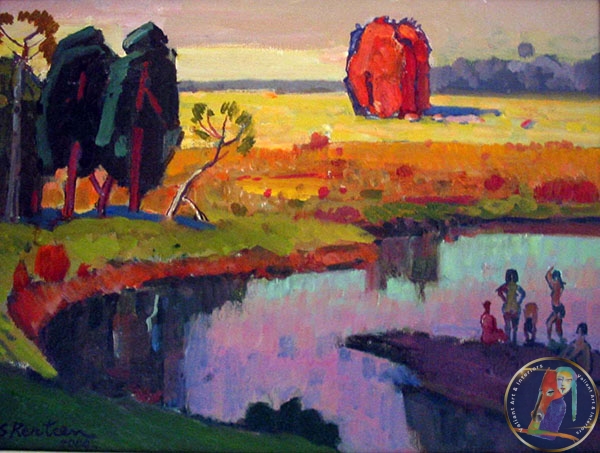
In this intimate oil study, Rentsen Suren captures the soul of his birthplace, the Arkhangai province of Mongolia. Despite its modest dimensions ($40 \times 30 \text{ cm}$), the work conveys a sense of vast, rhythmic openness characteristic of the Mongolian steppe. The composition centers on the Tsenher Valley, a region famed for its lush greenery and thermal springs, rendered here with a masterly balance of realism and atmospheric impressionism.
Technique and Color Palette
Suren utilizes a rich, tactile application of oil paint, likely informed by his academic training at the Pedagogical University of Mongolia. The palette is dominated by:
Earth Tones: Deep ochres and burnt sienna represent the rugged terrain and the cured hides of nomadic dwellings.
Verdant Greens: Varied hues of emerald and moss define the fertile valley floor.
Atmospheric Blues: The “Tsenher” (meaning “blue” or “light blue”) of the title is reflected in the distant, hazy mountains and the expansive sky, creating a profound sense of depth.
Cultural Context
As a highly decorated artist—having won top prizes at the Mongolian Youth First Festival (1958) and the 40th Anniversary of the Republic Revolution (1961)—Suren’s work serves as a patriotic homage to the Unification Movement and the nomadic lifestyle. The painting does not merely depict a landscape; it documents the spiritual connection between the Mongolian people and their ancestral lands.
Artistic Legacy
The brushwork reflects a mid-20th-century Mongolian aesthetic that blends traditional “Mongol Zurag” sensibilities with Western oil techniques. The piece stands as a testament to Suren’s status as a premier chronicler of the Mongolian landscape, capturing a moment of serenity in a province known as the “Switzerland of Mongolia.”
Tsenher Valley Of Arhangai Province is a definitive example of Suren’s ability to translate the monumental scale of the Central Asian plateau onto a compact, emotive canvas.