True And False

Odgerel Tsulbaatar , 2006 , Oil On Canvas

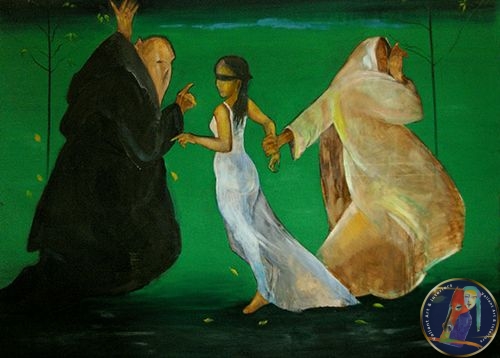
True and False is a monumental oil on canvas work, measuring an impressive 160 x 200cm. Created by the Ulaanbaatar-born artist Odgerel Tsulbaatar, the piece serves as a profound exploration of duality, blending the artist’s roots in figurative tradition with a sharp, contemporary abstract sensibility.

Composition and Visual Style

The painting is a masterful intersection of Modern Contemporary and Figurative styles. At this scale, the viewer is confronted with a landscape of contrasting textures and forms. Tsulbaatar utilizes the large format to create a sense of immersion, where the boundaries between reality and perception are intentionally blurred.

  • The Figurative Core: Central to the work is the human element, often rendered in a Portrait style that feels both intimate and distant. The figures typically possess a haunting quality, their features slightly distorted or layered to suggest internal conflict—the “True” self battling the “False” exterior.

  • Abstract Overlays: Broad, energetic brushstrokes and textured layers of oil paint sweep across the canvas. These abstract elements act as a visual “noise,” representing the social masks, lies, or societal pressures that obscure the truth.

  • Color Palette: The artist often employs a sophisticated palette where earthy, grounded tones (reminiscent of the Mongolian landscape) clash with sharp, modern synthetics. This contrast reinforces the theme of traditional authenticity versus modern artificiality.

Themes and Context

Given Tsulbaatar’s background and education at the Fine Art University in Ulaanbaatar, “True and False” reflects a generation of Mongolian artists navigating the shift from traditional socialist realism to globalized contemporary art.

The painting functions as a psychological study. The large dimensions allow the “False” elements—the heavy textures and obscured areas—to carry physical weight, making the search for the “True” figure within the composition a demanding task for the viewer. It echoes the themes explored in his 2006 exhibition, “Seeking the Real Feel I,” focusing on the raw, unfiltered human experience behind the surface of modern life.
  • Odgerel Tsulbaatar
  • Abstract, Figurative
  • Oil On Canvas
  • ODG43/009
  • 160 x 200cm
  • Mongolian Art Gallery

Add Your Comment

Mongolian Art Gallery © 2025. All Rights Reserved
Privacy Policy / Terms of Use

True and False is a monumental oil on canvas work, measuring an impressive 160 x 200cm. Created by the Ulaanbaatar-born artist Odgerel Tsulbaatar, the piece serves as a profound exploration of duality, blending the artist’s roots in figurative tradition with a sharp, contemporary abstract sensibility.

Composition and Visual Style

The painting is a masterful intersection of Modern Contemporary and Figurative styles. At this scale, the viewer is confronted with a landscape of contrasting textures and forms. Tsulbaatar utilizes the large format to create a sense of immersion, where the boundaries between reality and perception are intentionally blurred.

  • The Figurative Core: Central to the work is the human element, often rendered in a Portrait style that feels both intimate and distant. The figures typically possess a haunting quality, their features slightly distorted or layered to suggest internal conflict—the “True” self battling the “False” exterior.

  • Abstract Overlays: Broad, energetic brushstrokes and textured layers of oil paint sweep across the canvas. These abstract elements act as a visual “noise,” representing the social masks, lies, or societal pressures that obscure the truth.

  • Color Palette: The artist often employs a sophisticated palette where earthy, grounded tones (reminiscent of the Mongolian landscape) clash with sharp, modern synthetics. This contrast reinforces the theme of traditional authenticity versus modern artificiality.

Themes and Context

Given Tsulbaatar’s background and education at the Fine Art University in Ulaanbaatar, “True and False” reflects a generation of Mongolian artists navigating the shift from traditional socialist realism to globalized contemporary art.

The painting functions as a psychological study. The large dimensions allow the “False” elements—the heavy textures and obscured areas—to carry physical weight, making the search for the “True” figure within the composition a demanding task for the viewer. It echoes the themes explored in his 2006 exhibition, “Seeking the Real Feel I,” focusing on the raw, unfiltered human experience behind the surface of modern life.