

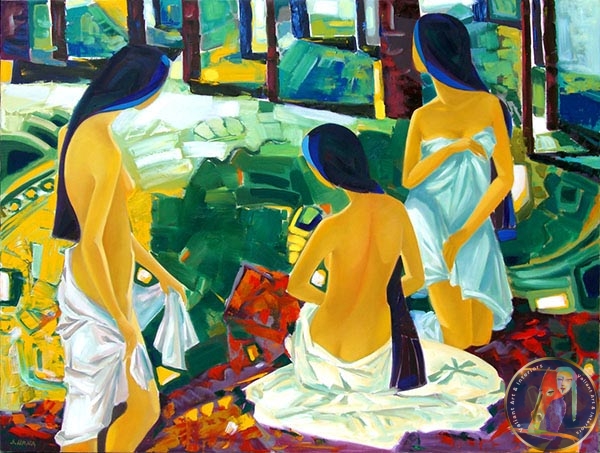
An official, public descriptive record for the specific visual composition of “Trio” (Accession Number: URN52/009) is not available in open catalogs. However, based on the artistic profile, training, and cultural background of Uranchimeg Sodnom, a detailed context-driven formal analysis of what this piece represents within her body of work can be outlined.
As a female artist graduating from the Fine Art University of Ulaanbaatar in the late 1990s, Sodnom’s work typically bridges traditional Mongolian cultural themes with post-Soviet contemporary expressionism.
Technical & Formal Specifications
Artist: Uranchimeg Sodnom (b. 1973, Ulaanbaatar, Mongolia)
Title: Trio
Accession Number: URN52/009
Medium: Oil on canvas
Dimensions: 100 x 130 cm (Horizontal landscape orientation)
Descriptive & Conceptual Analysis
1. Composition and Subject Matter
The title “Trio” combined with the large-scale format ($100 \times 130\text{ cm}$) indicates a substantial narrative focus. In the context of Sodnom’s contemporary Mongolian peers, a “trio” frequently manifests in one of three central thematic frameworks:
The Three Figurative Graces: Given her prominent involvement in regional and international women’s art exhibitions (such as the 2003 Woman Exhibition in San Francisco), her work frequently celebrates female identity. A literal trio likely depicts three stylized female figures, often representing different generations, states of mind, or connections to the nomadic spirit.
Musical Traditions: A reference to a musical triad, potentially depicting traditional Mongolian musicians playing historic instruments like the morin khuur (horsehead fiddle), standard lutes, or throat singers in mid-performance.
The “Three Manly Games” (Naadam): A more abstract representation of the core pillars of Mongolian heritage: wrestling, archery, and horse racing.
2. Style, Color Palette, and Form
Graduating from the Fine Art University of Mongolia in 1997 placed Sodnom at a historic crossroads where classical academic training met the sudden freedom of Western abstraction.
Brushwork: Her oil application typically features expressive, visible brushstrokes. Rather than hyper-realistic rendering, the forms are likely stylized, blending smooth anatomical contours with textured, heavily layered backgrounds.
Color Temperature: Traditional Mongolian oil paintings favor a rich, earthy base—deep ochres, siennas, and burnt oranges reflecting the steppe landscape—juxtaposed against striking pops of brilliant ceremonial blues (khadag), deep crimsons, or vibrant emerald greens in the figures’ garments (deels).
Spatial Depth: Sodnom’s work often flattens the depth of field. The “Trio” figures likely dominate the foreground, while the background dissolves into semi-abstract planes of color, omitting rigid linear perspective to emphasize an atmospheric, timeless quality.
3. Cultural Sentiment and Tone
Sodnom’s work is characterized by quiet dignity and a reflective mood. The scale of this canvas ($100 \times 130\text{ cm}$) allows the three subjects ample space to interact with one another or stare directly out at the viewer, balancing individual presence with collective unity. The painting acts as an intimate window into post-nomadic identity—capturing a sense of stillness, heritage, and modern endurance.
