
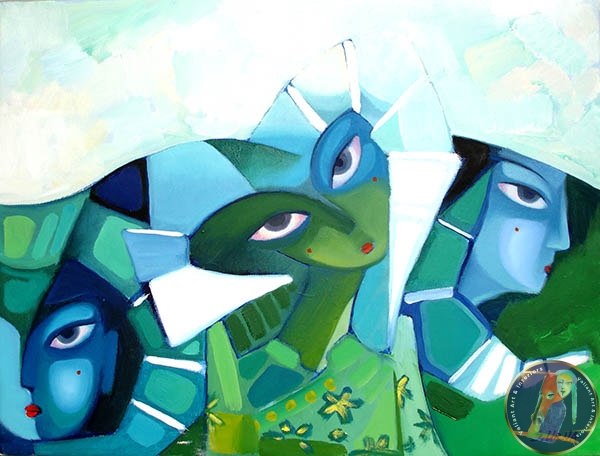
Three is an intimate yet impactful oil painting on a compact $30 \times 40\text{ cm}$ canvas, executed with the signature expressive brushwork characteristic of post-socialist Mongolian contemporary art. True to the title, the narrative architecture of the piece relies heavily on the rule of thirds and the symbolic weight of a triad—a concept deeply embedded in Mongolian philosophy, nomadism, and Buddhist thought (such as the balance of past, present, and future, or the harmony of earth, sky, and humanity).
Rather than relying on hyper-realistic details, Sodnom leverages her specialized training in illustration and fine arts to build an evocative, texture-heavy scene. The medium-sized canvas utilizes rich impasto layers (thickly applied paint) and dynamic brushstrokes that capture the raw, windswept nature of the Mongolian landscape.
Color Palette & Atmospheric Depth
The color palette acts as a bridge between the physical realities of Mongolian steppes and a highly emotional, psychological landscape.
Dominant Tones: A sweeping interplay of earthy ochres, deep terracottas, and weathered tans anchor the lower half of the frame, mirroring the semi-arid ground or the rustic materials of traditional nomadic life.
Counter-tones: These rich, warm hues are contrasted with atmospheric cooler tones—muted slate blues, soft indigos, or hazy greys in the upper registers of the canvas—suggesting a vast, unyielding sky or an enveloping twilight.
Subject Matter & Thematic Resonance
At the heart of the canvas, the “Three” subjects act as a focal anchor. Given Sodnom’s artistic background and thematic focus, this motif masterfully depicts either a trio of majestic figures central to nomadic heritage (such as horses or camels navigating the elements) or a cluster of traditional gers (yurts) standing in unified defiance against the vast emptiness of the plains.
There is an intentional blur between abstraction and figuration. The subjects are not painted with clinical sharpness; instead, they emerge organically from the background through broad, confident palette knife work and blended edges. This artistic choice forces the viewer’s eye to piece together the forms, creating a profound sense of isolation, quiet endurance, and the cyclical rhythm of life on the steppe. The compact scale of the canvas isolates this singular, poignant moment, turning a small window into an expansive meditation on Mongolian identity.