Three Brothers

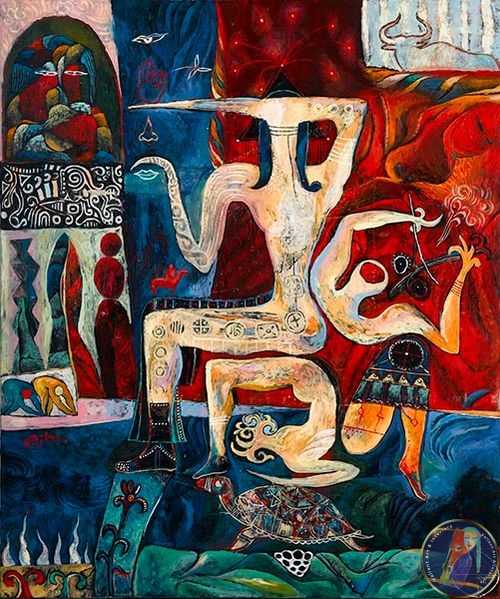
Oilan Janatkhan , 2005 , Oil On Canvas

Three Brothers is a compelling oil on canvas work by Mongolian artist Oilan Janatkhan. Measuring 120 x 100cm, this substantial piece serves as a profound exploration of familial bonds, cultural identity, and the intersection of traditional Mongolian heritage with modern expressionist techniques.

Visual Composition and Style

The painting occupies a space between Portraiture and Abstract Expressionism. Rather than focusing on hyper-realistic anatomical detail, Janatkhan uses bold, emotive brushwork to capture the “spirit” of the three subjects. The composition is tightly framed, emphasizing the physical and emotional proximity of the brothers.

  • Color Palette: The work features a rich, earthy palette indicative of the Mongolian landscape—deep ochres, burnt sienna, and cool shadows—interspersed with vibrant, sudden strokes of color that suggest movement and life.

  • Texture: Consistent with Janatkhan’s formal training and contemporary style, the oil paint is applied with varied thickness. Areas of impasto create a tactile quality that gives the subjects a rugged, monumental presence.

  • Forms: The figures are rendered with a degree of abstraction. Their features are elongated and stylized, echoing the aesthetic of nomadic history while remaining firmly rooted in a modern, avant-garde sensibility.

Symbolism and Context

Created in 2005, this piece reflects Janatkhan’s established “Modern/Contemporary” voice. Having exhibited extensively across Europe and Asia—including Paris, Amsterdam, and Istanbul—the artist brings a global perspective to a deeply personal subject.

  • The Trinity: The arrangement of the three figures suggests a pillar of strength. There is a sense of shared history and a collective gaze that looks toward the viewer (or perhaps the future) with a mixture of stoicism and intensity.

  • Cultural Dialogue: The painting acts as a bridge. It utilizes the Western medium of oil on canvas and the stylistic cues of 20th-century Expressionism to articulate a narrative that is uniquely Central Asian.
  • Oilan Janatkhan
  • Calligraphy, Figurative
  • Oil On Canvas
  • OLY46/005
  • 120 x 100cm
  • Mongolian Art Gallery

Add Your Comment

Mongolian Art Gallery © 2025. All Rights Reserved
Privacy Policy / Terms of Use

Three Brothers is a compelling oil on canvas work by Mongolian artist Oilan Janatkhan. Measuring 120 x 100cm, this substantial piece serves as a profound exploration of familial bonds, cultural identity, and the intersection of traditional Mongolian heritage with modern expressionist techniques.

Visual Composition and Style

The painting occupies a space between Portraiture and Abstract Expressionism. Rather than focusing on hyper-realistic anatomical detail, Janatkhan uses bold, emotive brushwork to capture the “spirit” of the three subjects. The composition is tightly framed, emphasizing the physical and emotional proximity of the brothers.

  • Color Palette: The work features a rich, earthy palette indicative of the Mongolian landscape—deep ochres, burnt sienna, and cool shadows—interspersed with vibrant, sudden strokes of color that suggest movement and life.

  • Texture: Consistent with Janatkhan’s formal training and contemporary style, the oil paint is applied with varied thickness. Areas of impasto create a tactile quality that gives the subjects a rugged, monumental presence.

  • Forms: The figures are rendered with a degree of abstraction. Their features are elongated and stylized, echoing the aesthetic of nomadic history while remaining firmly rooted in a modern, avant-garde sensibility.

Symbolism and Context

Created in 2005, this piece reflects Janatkhan’s established “Modern/Contemporary” voice. Having exhibited extensively across Europe and Asia—including Paris, Amsterdam, and Istanbul—the artist brings a global perspective to a deeply personal subject.

  • The Trinity: The arrangement of the three figures suggests a pillar of strength. There is a sense of shared history and a collective gaze that looks toward the viewer (or perhaps the future) with a mixture of stoicism and intensity.

  • Cultural Dialogue: The painting acts as a bridge. It utilizes the Western medium of oil on canvas and the stylistic cues of 20th-century Expressionism to articulate a narrative that is uniquely Central Asian.