
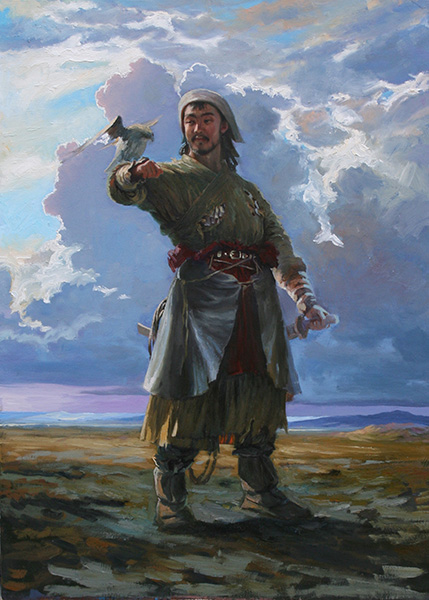
Temuujin

Batjargal Tseintsogzol , 2008 , Oil On Canvas

In this work, Tseintsogzol moves away from the typical “warrior-king” iconography often associated with Mongolian history. Instead, he focuses on Temuujin (the birth name of Genghis Khan) as a young man, grounding the historical figure in the harsh yet beautiful reality of the Mongolian steppe.

  • Subjectivity and Presence: The portrait is characterized by an intense, lifelike gaze. Tseintsogzol’s background in photorealism is evident in the meticulous rendering of the skin’s texture, the subtle weathering of the face from the wind, and the reflective depth in the eyes.

  • Texture and Materiality: The 50 x 70 cm canvas provides an intimate window into the 12th-century lifestyle. The artist demonstrates exceptional skill in depicting traditional materials—the coarse weave of the wool, the intricate stitching of the deel (traditional robe), and the organic sheen of fur trim.

  • Lighting and Atmosphere: The lighting is soft and directional, reminiscent of the “Golden Hour” on the plateau. This creates a high-contrast play between light and shadow (chiaroscuro) that gives the subject a three-dimensional, sculptural quality against a muted, atmospheric background.

The Artist’s Legacy

Batjargal Tseintsogzol was a pivotal figure in the Ulaanbaatar art scene. His work often bridged the gap between academic realism and a deeply personal naturalism. In Temuujin, he doesn’t just paint a historical figure; he paints a soul. The composition emphasizes the resilience and quiet strength inherent in the nomadic identity, making the painting feel both like a historical artifact and a living breath.

Note on Style: While the work is categorized as Photorealism, Tseintsogzol retains a “painterly” warmth that avoids the clinical coldness sometimes found in the genre. Every brushstroke serves to honor the heritage of Mongolia.
  • Batjargal Tseintsogzol
  • Geometric, Minimalist, Photorealism
  • Oil On Canvas
  • 50 x 70cm
  • Mongolian Art Gallery

Add Your Comment

Mongolian Art Gallery © 2025. All Rights Reserved
Privacy Policy / Terms of Use

In this work, Tseintsogzol moves away from the typical “warrior-king” iconography often associated with Mongolian history. Instead, he focuses on Temuujin (the birth name of Genghis Khan) as a young man, grounding the historical figure in the harsh yet beautiful reality of the Mongolian steppe.

  • Subjectivity and Presence: The portrait is characterized by an intense, lifelike gaze. Tseintsogzol’s background in photorealism is evident in the meticulous rendering of the skin’s texture, the subtle weathering of the face from the wind, and the reflective depth in the eyes.

  • Texture and Materiality: The 50 x 70 cm canvas provides an intimate window into the 12th-century lifestyle. The artist demonstrates exceptional skill in depicting traditional materials—the coarse weave of the wool, the intricate stitching of the deel (traditional robe), and the organic sheen of fur trim.

  • Lighting and Atmosphere: The lighting is soft and directional, reminiscent of the “Golden Hour” on the plateau. This creates a high-contrast play between light and shadow (chiaroscuro) that gives the subject a three-dimensional, sculptural quality against a muted, atmospheric background.

The Artist’s Legacy

Batjargal Tseintsogzol was a pivotal figure in the Ulaanbaatar art scene. His work often bridged the gap between academic realism and a deeply personal naturalism. In Temuujin, he doesn’t just paint a historical figure; he paints a soul. The composition emphasizes the resilience and quiet strength inherent in the nomadic identity, making the painting feel both like a historical artifact and a living breath.

Note on Style: While the work is categorized as Photorealism, Tseintsogzol retains a “painterly” warmth that avoids the clinical coldness sometimes found in the genre. Every brushstroke serves to honor the heritage of Mongolia.