
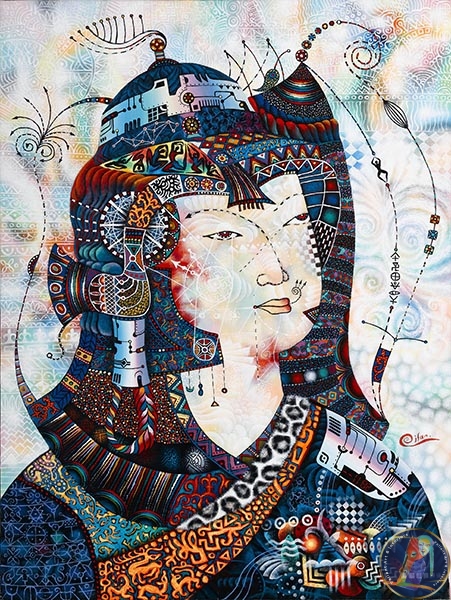
In this 2006 masterpiece, Oilan Janatkhan presents a soul-stirring portrait of Temuujin (the birth name of Genghis Khan), blending the artist’s Mongolian heritage with a sophisticated Abstract Expressionist sensibility. Rather than a traditional historical depiction, the painting functions as an evocative psychological study, capturing the raw intensity and burgeoning destiny of the man who would forge an empire.
Composition and Style
Janatkhan utilizes a vertical 80 x 60 cm format to focus tightly on the subject, creating an intimate yet monumental presence. The work is characterized by:
Expressive Brushwork: Thick, gestural applications of oil paint create a sense of movement and “living” history. The texture suggests the rugged landscapes of the Mongolian steppe and the weathered resilience of its people.
Color Palette: The artist employs a rich, earthy palette dominated by deep ochres, burnt sienna, and charcoal shadows, punctuated by flashes of celestial blues or crimson. This color choice bridges the gap between the physical earth and the spiritual “Eternal Blue Sky” (Tenger).
Abstracted Form: While the features of the face are recognizable, Janatkhan allows the forms to dissolve into abstract strokes at the edges. This technique suggests that Temuujin is a figure emerging from the mists of time—less a static person and more a force of nature.
Thematic Depth
The painting reflects Janatkhan’s background and his education at the Institute of Fine Art. By stripping away the typical iconography of a conqueror—such as armor or weaponry—the artist focuses on the internal fire of the subject. The eyes, often a focal point in Janatkhan’s portraiture, carry a piercing, visionary weight that hints at the “Universal Ruler” to come.
Contextual Significance
Created during a period when Janatkhan was gaining significant international traction—following exhibitions in major art hubs like Paris, Amsterdam, and Hamburg—Temuujin stands as a definitive example of Mongolian Modern/Contemporary art. It successfully marries Central Asian nomadic identity with the global language of mid-20th-century abstraction, cementing Janatkhan’s reputation as a bridge between tradition and the avant-garde.