
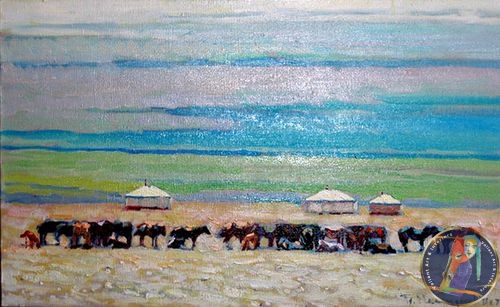
Sudalvar X is a masterclass in Mongolian Realism, rendered in oil on a modest 28 x 46cm canvas. The painting captures a sweeping, cinematic perspective of the Mongolian landscape, likely informed by Tsendsuren’s extensive training in mural painting. The composition is defined by a deep atmospheric perspective, where the vastness of the steppe is translated through delicate tonal shifts.
The foreground is anchored by rich, earthy textures—tufts of hardy grassland and the subtle undulations of the terrain—painted with the precision expected of a realist master. As the eye moves toward the horizon, the colors transition from vibrant natural greens and ochres into the soft, hazy blues and violets characteristic of the high-altitude Mongolian sky. The play of light suggests a specific moment in time, perhaps the fleeting clarity of early morning or the soft descent of dusk, casting gentle shadows that give the rolling hills a sculptural quality.
Artistic Context & Technique
Created in 2005, this work represents the peak of Tsendsuren’s mature style. While the subject is rooted in the “Nature and Landscape” style, the execution reveals a sophisticated European influence derived from his years at UMPRUM in Prague. The “Mural Painting” discipline is evident here; despite the small scale of the canvas, the work feels monumental, possessing a structural integrity and a sense of “breathable” space that mimics large-scale wall works.
Artist Profile: Narangerel Tsendsuren
Narangerel Tsendsuren (b. 1956) is a pillar of the Mongolian contemporary art scene. Born in Ulaanbaatar, his career bridges the gap between traditional Mongolian aesthetics and rigorous academic training.
Academic Foundation:
College of Fine Art, Ulaanbaatar (1971–1976): Provided the fundamental technical skills in drawing and composition.
UMPRUM, Prague (1980–1986): Specialized in the class of mural painting, which introduced a structured, architectural approach to his landscapes.
Professional Standing: Tsendsuren is not merely a painter but a significant educator and leader. Since 1991, he has served as the Dean of the Institute of Fine Art, shaping the next generation of Mongolian artists. His long-standing involvement with the Union of Mongolian Artists (UMA)—serving as both a member since 1987 and a recurring board member—marks him as a central figure in the preservation and evolution of Mongolian Realism.