
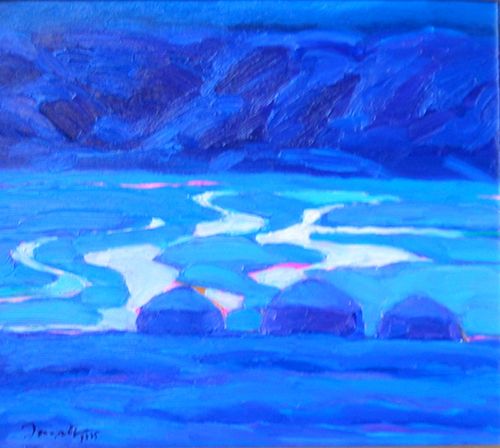
Sudalvar Viii

Enkhjargal Tsagaandari , 2006 , Oil On Canvas

In Sudalvar VIII, Enkhjargal Tsagaandari masterfully bridges the gap between Modern Abstraction and the raw, rhythmic energy of the Mongolian Landscape. The painting is a sophisticated exploration of texture and layered space, characteristic of the artist’s transition into freelance mastery after years of monumental and academic work.

The composition does not lean on a traditional horizon line. Instead, it utilizes a “top-down” or immersive perspective, where the subject matter—implied by the title Sudalvar (meaning “pattern,” “vein,” or “groove” in Mongolian)—dominates the canvas. The work functions as a topographical study, capturing the anatomical “pulse” of the earth.

Color Palette and Texture

True to her roots in Ulaanbaatar and her experience with monumental art, Tsagaandari employs a palette that feels both organic and atmospheric:

  • Earth Tones: Rich ochres, deep umbers, and burnt sienna provide a grounded, tectonic foundation.

  • Atmospheric Accents: Subtle washes of slate gray and muted turquoise suggest the presence of mineral deposits or the play of light over weathered rock and steppe.

  • Tactile Quality: The oil paint is applied with varying density. In some areas, the paint is translucent and fluid; in others, it is impasto-heavy, creating a physical relief on the canvas that mimics the rugged Mongolian terrain.

Symbolism and Interpretation

The “VIII” in the title suggests this is part of a larger meditative series. In this specific iteration, the Figurative elements mentioned in the artist’s profile are sublimated into the Abstract. The “veins” or lines moving across the canvas can be interpreted in several ways:

  1. Hydrological: The winding paths of dried riverbeds or seasonal streams across the Gobi.

  2. Biological: The microscopic view of muscle fiber or wood grain, reflecting the interconnectedness of nature.

  3. Cultural: A nod to the intricate patterns found in traditional Mongolian craftsmanship and monumental design.

Artistic Context

Created in 2006, this piece represents Tsagaandari’s mature period. After a decade of teaching at the College of Fine Art, Sudalvar VIII exhibits a liberation from rigid academic structures. It carries the scale of her “Monumental Art” background but focuses it into the intimate, 30 x 40-inch frame, inviting the viewer to look into the earth rather than just at it.

The work stands as a testament to the Contemporary Mongolian art movement—retaining a deep, spiritual connection to the land while speaking the universal language of mid-century abstraction.

  • Enkhjargal Tsagaandari
  • Photorealism, Sculpture
  • Oil On Canvas
  • ENJ25/003
  • 30 x 40
  • Mongolian Art Gallery

Add Your Comment

Mongolian Art Gallery © 2025. All Rights Reserved
Privacy Policy / Terms of Use

In Sudalvar VIII, Enkhjargal Tsagaandari masterfully bridges the gap between Modern Abstraction and the raw, rhythmic energy of the Mongolian Landscape. The painting is a sophisticated exploration of texture and layered space, characteristic of the artist’s transition into freelance mastery after years of monumental and academic work.

The composition does not lean on a traditional horizon line. Instead, it utilizes a “top-down” or immersive perspective, where the subject matter—implied by the title Sudalvar (meaning “pattern,” “vein,” or “groove” in Mongolian)—dominates the canvas. The work functions as a topographical study, capturing the anatomical “pulse” of the earth.

Color Palette and Texture

True to her roots in Ulaanbaatar and her experience with monumental art, Tsagaandari employs a palette that feels both organic and atmospheric:

  • Earth Tones: Rich ochres, deep umbers, and burnt sienna provide a grounded, tectonic foundation.

  • Atmospheric Accents: Subtle washes of slate gray and muted turquoise suggest the presence of mineral deposits or the play of light over weathered rock and steppe.

  • Tactile Quality: The oil paint is applied with varying density. In some areas, the paint is translucent and fluid; in others, it is impasto-heavy, creating a physical relief on the canvas that mimics the rugged Mongolian terrain.

Symbolism and Interpretation

The “VIII” in the title suggests this is part of a larger meditative series. In this specific iteration, the Figurative elements mentioned in the artist’s profile are sublimated into the Abstract. The “veins” or lines moving across the canvas can be interpreted in several ways:

  1. Hydrological: The winding paths of dried riverbeds or seasonal streams across the Gobi.

  2. Biological: The microscopic view of muscle fiber or wood grain, reflecting the interconnectedness of nature.

  3. Cultural: A nod to the intricate patterns found in traditional Mongolian craftsmanship and monumental design.

Artistic Context

Created in 2006, this piece represents Tsagaandari’s mature period. After a decade of teaching at the College of Fine Art, Sudalvar VIII exhibits a liberation from rigid academic structures. It carries the scale of her “Monumental Art” background but focuses it into the intimate, 30 x 40-inch frame, inviting the viewer to look into the earth rather than just at it.

The work stands as a testament to the Contemporary Mongolian art movement—retaining a deep, spiritual connection to the land while speaking the universal language of mid-century abstraction.