
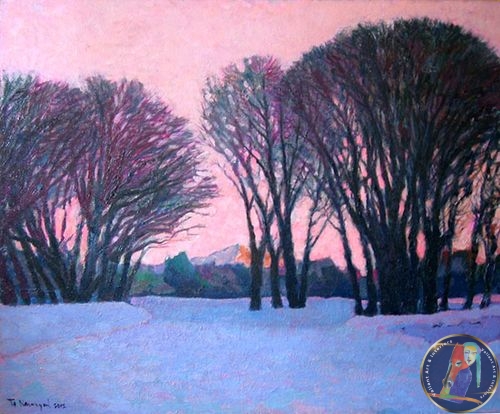
Sudalvar VIII is a masterclass in contemporary Mongolian realism, reflecting Narangerel Tsendsuren’s profound connection to the natural world. Painted in 2005, this large-scale oil on canvas captures the rugged, rhythmic beauty of the Mongolian landscape through a lens that balances academic precision with a deep, atmospheric soul.
The painting likely focuses on the organic textures of the earth—the “Sudalvar” (veins or ripples)—which suggests a study of geological formations, flowing water, or the weathered patterns of the steppe. Tsendsuren utilizes his extensive training in mural painting from Prague’s UMPRUM to command the 122 x 100.5 cm space, treating the canvas with a monumental sensibility that makes the viewer feel small in the face of nature’s vastness.
Color Palette and Technique
The color story is grounded in the earthy, muted tones characteristic of the Mongolian plateau:
Ochres and Umbers: Representing the sun-drenched soil and ancient stone.
Deep Grays and Slate: Providing shadow and structural depth to the landscape’s “veins.”
Subtle Highlights: Used to indicate the play of light over uneven surfaces, creating a tactile quality that invites the viewer to imagine the roughness of the terrain.
Tsendsuren’s brushwork is deliberate and layered. His background in Realism is evident in the anatomical accuracy of the land, yet there is a fluidity to the strokes that hints at the constant movement of wind and time.
Artistic Context and Legacy
Created during his tenure as the Dean of the Institute of Fine Art, this piece represents Tsendsuren at the height of his technical and influential powers. Having transitioned from the rigid socialist realism of his early education in Ulaanbaatar to the more expansive, expressive mural traditions of the Czech Republic, Sudalvar VIII stands as a bridge between tradition and modern environmental observation.
“In Sudalvar VIII, the landscape is not merely a backdrop but a living subject, possessing its own pulse and history.”
The work serves as a testament to Tsendsuren’s role as a guardian of Mongolian aesthetics, blending the vast, silent energy of his homeland with the sophisticated structural techniques of European fine art.