
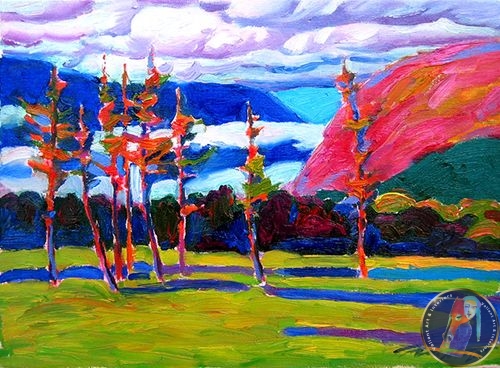
Sudalvar V (2005) is a compelling oil on canvas work by the renowned Mongolian artist Enkhjargal Tsagaandari. Measuring 30 x 40cm, this piece serves as a sophisticated exploration of the artist’s signature fusion of abstract expressionism and nature-inspired figurativism.
Visual Composition and Style
The painting captures a rhythmic, almost musical interpretation of the Mongolian landscape. Moving away from rigid realism, Tsagaandari utilizes a modern, contemporary lens to deconstruct natural forms into a series of fluid lines and organic shapes. The title, Sudalvar (meaning “sketch” or “study”), suggests an intimate, experimental approach where the artist prioritizes the “soul” or movement of the subject over anatomical precision.
The brushwork is confident and textured, typical of the artist’s background in monumental art and academic instruction. Despite the modest dimensions of the canvas, the composition feels expansive, utilizing a palette that balances earthy tones with the ethereal light often found in the high-altitude environments of Mongolia.
Artistic Context
Created in 2005, during Tsagaandari’s established period as a freelance artist, this work reflects a mastery of both form and void. Having spent decades as both an educator at the College of Fine Art and a practicing artist within the Union of Mongolian Artists (UMA), Tsagaandari weaves together the discipline of his early monumental atelier training with the freedom of contemporary abstraction.
Movement and Energy: The piece is characterized by a sense of perpetual motion, where the “Sudalvar” series acts as a visual dialogue between the artist’s internal emotions and the external world.
Thematic Depth: As a figure born and raised in Ulaanbaatar, Tsagaandari’s work often bridges the gap between urban modernity and the profound, silent power of the Mongolian steppe.
This painting stands as a testament to the artist’s ability to translate the vastness of nature into a concentrated, poetic visual language, making it a significant example of early 21st-century Mongolian modernism.