

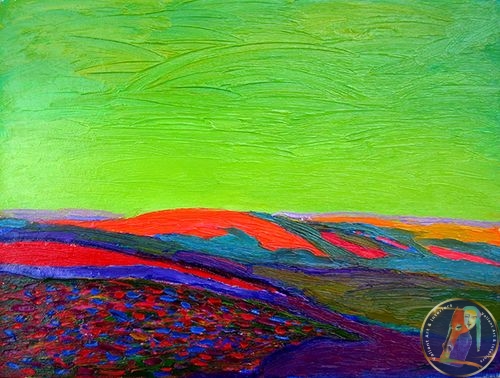
Sudalvar IV is a compelling oil on canvas work created in 2005 by the renowned Mongolian contemporary artist Enkhjargal Tsagaandari. Measuring 30 x 40 cm, this piece serves as an intimate exploration of the artist’s signature fusion of nature-inspired abstraction and figurative modernism.
The composition reflects Tsagaandari’s deep-rooted connection to the Mongolian landscape, interpreted through a lens of sophisticated contemporary abstraction. In this work, the artist moves beyond mere representation, using the tactile qualities of oil paint to create a rich, layered surface that suggests the rugged textures of the natural world. The title, “Sudalvar,” suggests a study or an anatomical mapping, hinting at a rhythmic exploration of forms—perhaps the undulating lines of the steppe, the structural grace of organic elements, or the fluid movement of the wind.
Drawing from her extensive background in monumental art and academic teaching, Tsagaandari employs a masterful balance of color and space. Despite the modest scale of the canvas, the work possesses an expansive energy. The palette likely oscillates between the earthy, grounded tones of the Mongolian terrain and more ethereal, modern accents that define her “Spring” and “Nature” series.
About the Artist: Enkhjargal Tsagaandari
Born in 1960 in Ulaanbaatar, Enkhjargal Tsagaandari is a pivotal figure in the evolution of Mongolian contemporary art. Her career spans several decades of significant institutional and freelance work, transitioning from a formal artist for the Union of Mongolian Artists (UMA) and the Military Institute in the 1980s to a respected educator at the College of Fine Art in the late 1990s.
Since becoming a freelance artist in 2000, Tsagaandari has focused on developing a visual language that bridges traditional Mongolian sensibilities with international modernism. Her participation in international exhibitions—ranging from Beijing (1988) to Vienna (1989)—highlights her role in introducing Mongolian contemporary perspectives to a global audience. Sudalvar IV stands as a testament to this period of creative independence, showcasing a mature style that is at once technically precise and emotionally resonant.
