Sudalvar Ii

Narangerel Tsendsuren , 2005 , Oil On Canvas

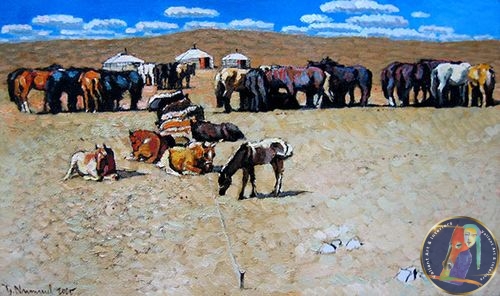
Sudalvar II is a compelling testament to Narangerel Tsendsuren’s mastery of Realism and his deep-seated connection to the Mongolian landscape. Painted in 2005, the work captures the rugged, rhythmic beauty of the natural world through a panoramic lens. The horizontal orientation of the canvas (45.7 x 78.8 cm) emphasizes the vastness of the terrain, a hallmark of the artist’s Ulaanbaatar roots and his formal training in mural painting from Prague’s UMPRUM.

Composition and Technique

The painting is characterized by a sophisticated interplay of light and geological texture. Tsendsuren utilizes his background in mural arts to give the landscape a sense of monumental scale, despite the medium-sized canvas.

  • Geological Focus: The title, likely referencing “veins” or “striations” (Sudal), is reflected in the detailed rendering of rock formations and earth. The artist uses nuanced brushwork to trace the “sudal” of the land—the natural lines, ridges, and grooves carved by time and erosion.

  • Color Palette: The palette is grounded in earthy tones—ochres, deep ambers, and cool slate greys—punctuated by the atmospheric light typical of the Mongolian steppe. The transition of colors suggests a specific time of day, possibly late afternoon, where long shadows emphasize the three-dimensionality of the terrain.

  • Stylistic Influence: While strictly Realist, there is a rhythmic, almost lyrical quality to the way the hills or rock faces are arranged. This reflects Tsendsuren’s education in the Czech Republic, blending European technical precision with the expansive, spiritual perspective of Mongolian nature.

Atmospheric Quality

Tsendsuren’s work often transcends mere documentation; Sudalvar II evokes a sense of stillness and permanence. The absence of human figures directs the viewer’s full attention to the “skin” of the earth. The texture of the oil paint is applied with varying thickness—smooth glazes for the distant sky and more tactile, impasto-leaning strokes for the foreground crags—creating a physical depth that invites the eye to wander across the ridges.
  • Narangerel Tsendsuren
  • Calligraphy, Mongolian Style
  • Oil On Canvas
  • NAT41/004
  • 45.7 x 78.8cm
  • Mongolian Art Gallery

Add Your Comment

Mongolian Art Gallery © 2025. All Rights Reserved
Privacy Policy / Terms of Use

Sudalvar II is a compelling testament to Narangerel Tsendsuren’s mastery of Realism and his deep-seated connection to the Mongolian landscape. Painted in 2005, the work captures the rugged, rhythmic beauty of the natural world through a panoramic lens. The horizontal orientation of the canvas (45.7 x 78.8 cm) emphasizes the vastness of the terrain, a hallmark of the artist’s Ulaanbaatar roots and his formal training in mural painting from Prague’s UMPRUM.

Composition and Technique

The painting is characterized by a sophisticated interplay of light and geological texture. Tsendsuren utilizes his background in mural arts to give the landscape a sense of monumental scale, despite the medium-sized canvas.

  • Geological Focus: The title, likely referencing “veins” or “striations” (Sudal), is reflected in the detailed rendering of rock formations and earth. The artist uses nuanced brushwork to trace the “sudal” of the land—the natural lines, ridges, and grooves carved by time and erosion.

  • Color Palette: The palette is grounded in earthy tones—ochres, deep ambers, and cool slate greys—punctuated by the atmospheric light typical of the Mongolian steppe. The transition of colors suggests a specific time of day, possibly late afternoon, where long shadows emphasize the three-dimensionality of the terrain.

  • Stylistic Influence: While strictly Realist, there is a rhythmic, almost lyrical quality to the way the hills or rock faces are arranged. This reflects Tsendsuren’s education in the Czech Republic, blending European technical precision with the expansive, spiritual perspective of Mongolian nature.

Atmospheric Quality

Tsendsuren’s work often transcends mere documentation; Sudalvar II evokes a sense of stillness and permanence. The absence of human figures directs the viewer’s full attention to the “skin” of the earth. The texture of the oil paint is applied with varying thickness—smooth glazes for the distant sky and more tactile, impasto-leaning strokes for the foreground crags—creating a physical depth that invites the eye to wander across the ridges.