
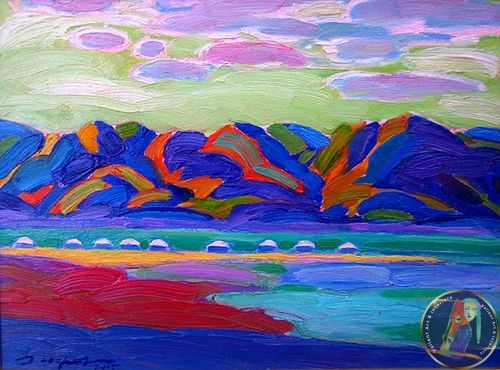
Visual Composition and Subject Matter Sudalvar I is an evocative exploration of the Mongolian landscape, viewed through the lens of Enkhjargal Tsagaandari’s signature blend of figurative and abstract sensibilities. The composition focuses on the organic textures and the inherent rhythm of nature, likely referencing the geological or botanical “veining” (Sudalvar) found within the earth. Despite its modest 30 x 40 cm dimensions, the work possesses an expansive quality, utilizing a sophisticated interplay of light and shadow to create a sense of depth and atmospheric mystery.
Style and Technique True to the artist’s background in monumental art and academic instruction, the brushwork in Sudalvar I is both deliberate and expressive. Tsagaandari employs oil paint with a tactile sensitivity, layering pigments to build a surface that feels weathered and ancient. The style sits at the intersection of contemporary abstraction and traditional landscape, where the physical features of the land are distilled into essential forms. There is a visible tension between the fluid, naturalistic curves and the structured, almost architectural weight of the oil medium.
Color Palette and Mood The palette is deeply rooted in the natural world, likely utilizing earthy ochres, deep ambers, and muted mineral tones that reflect the Mongolian steppe or mountain terrain. The lighting within the painting is subtle, favoring a soft, diffused glow that emphasizes the “veins” of the subject matter, suggesting a hidden energy beneath the surface. The overall mood is one of quiet contemplation and enduring strength, capturing a moment of stillness within a vast, living environment.
Artistic Context Created during Tsagaandari’s established period as a freelance artist, Sudalvar I represents a maturation of the themes he explored during his earlier career with the Union of Mongolian Artists. It reflects a departure from the rigid monumentalism of the late 20th century toward a more personal, poetic interpretation of nature. The work stands as a testament to his ability to translate the grandeur of the Mongolian outdoors into an intimate, modern format.