
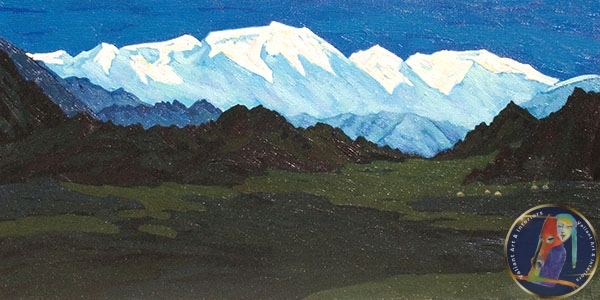
Sudalvar 5 is an oil painting executed on a wide, horizontal landscape-oriented canvas measuring 40 by 80 centimeters. This panoramic aspect ratio naturally mimics the human field of view, creating an expansive, cinematic perspective that draws the viewer’s eye across the composition from left to right. The layout balances structural weight with atmospheric openness, a hallmark of modern Mongolian landscape and figurative art.
Artistic Style & Technique
The painting bridges Realism and Expressionism, blending academic training from the College of Fine Art in Ulaanbaatar and the Institute of Industrial Art in Kharkiv, Ukraine, with a uniquely Central Asian perspective.
Brushwork: The application of the oil paint relies on an expressive, textured technique. Rather than perfectly smoothed gradients, visible brushstrokes and alternating thick and thin passages of paint create physical dimension on the canvas.
The “Sudalvar” Form: The word “Sudalvar” translates to “study” or “sketch” in Mongolian art terminology. Despite its designation as a study, the execution is deliberate and polished, balancing the spontaneous freedom of a field sketch with the compositional permanence of a finished studio canvas.
Subject Matter & Imagery
Rooted in the artist’s background and thematic focus, the painting portrays elements of traditional Mongolian life, land, or figure studies.
The Focal Elements: The composition utilizes the wide canvas to isolate or contrast its subjects against a expansive backdrop. If capturing the nomadic landscape, the elements represent the rolling terrain, steppes, or abstract horizons characteristic of the region. If incorporating figures or portrait elements (styles central to Usukhbayar’s portfolio), they are rendered with heavy structural forms and localized features, conveying a grounded sense of heritage.
Atmosphere and Light: The handling of light is atmospheric, creating a sense of distance and vast scale. The horizon line is purposefully placed—either dramatically low to emphasize a looming, expressive sky, or high up to lock the focus onto the immediate textures of the earth or the forms occupying the foreground.
Color Palette
The colors are selected to reflect natural environments alongside expressive emotional weight:
Dominant Tones: A harmonious blend of earthy pigments—ochres, deep umbers, and siennas—anchors the canvas, reminiscent of the natural tones of the steppe.
Atmospheric Accents: Muted blues, cool grays, or soft creams are worked into the upper registers and background to create atmospheric depth and simulate natural daylight.
Expressionistic Highlights: Subtle, unexpected shifts in saturation or color temperature within the shadows or highlights hint at the artist’s European training, elevating the piece from a literal replication of a scene into a subjective, painterly interpretation.