Steppe With Mountain, 2 Gers

Khurelbaatar Choindon , 2006 , Oil On Canvas

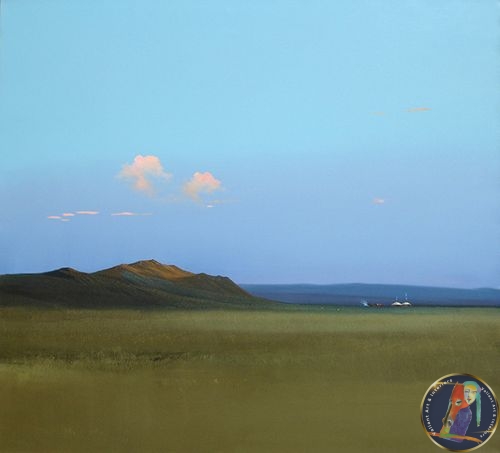
This masterful oil on canvas by Khurelbaatar Choindon is a quintessential example of Mongolian photorealism. Measuring 90 x 100cm, the piece serves as a window into the vast, serene soul of the Central Asian highlands, balancing technical precision with a deep, atmospheric reverence for the nomadic landscape.


Composition and Subject Matter

The painting is anchored by the presence of two Gers (traditional Mongolian dwellings), positioned in the middle ground. They are rendered with meticulous detail, capturing the textured felt coverings and the structural integrity of the round tents.

  • The Foreground: A sprawling expanse of the Mongolian steppe, painted with a nuanced palette of ochre, sage, and dusty golds. The artist uses fine brushwork to suggest the individual stalks of hardy grassland, creating a sense of tactile depth.

  • The Middle Ground: The two Gers act as the focal point, symbolizing the harmony between human habitation and the natural world. Their white surfaces catch the light, providing a sharp, clean contrast against the earthy tones of the earth.

  • The Background: Dominating the upper third of the canvas is a majestic mountain range. Choindon utilizes his training from the Repin Academy to masterfully handle atmospheric perspective; the peaks appear in cool, hazy blues and purples, suggesting immense distance and the thin, crisp air of high altitudes.


Style and Technique

Drawing from the Photorealist and Realist traditions, Choindon avoids the abstraction often seen in modern landscapes, opting instead for a “high-definition” clarity.

  • Light and Shadow: The lighting suggests either the soft, elongated shadows of early morning or the golden hour of late afternoon. This directional light emphasizes the undulations of the steppe and the solid geometry of the Gers.

  • Color Palette: The artist employs a naturalistic palette dominated by earth tones. However, it is the subtle variations in these colors—the transition from the warm grass to the cool, shadowed crevices of the distant mountains—that give the painting its lifelike quality.

  • Texture: Through the medium of oil, Choindon achieves a variety of textures, from the “softness” of the distant clouds and mountain haze to the rugged, weathered feel of the Mongolian plains.


Artistic Significance

Created in 2006, this work reflects Choindon’s peak maturity as a painter and his role as a leading figure in the Union of Mongolian Artists (UMA). It captures a timeless stillness, portraying the steppe not just as a location, but as a silent, powerful character. The influence of his Russian academic training is evident in the structural rigor of the mountains, yet the soul of the piece remains uniquely Mongolian—vast, quiet, and profoundly resilient.
  • Khurelbaatar Choindon
  • Landscape, Nature
  • Oil On Canvas
  • KBR31/010
  • 90 x 100cm

Add Your Comment

Mongolian Art Gallery © 2025. All Rights Reserved
Privacy Policy / Terms of Use

This masterful oil on canvas by Khurelbaatar Choindon is a quintessential example of Mongolian photorealism. Measuring 90 x 100cm, the piece serves as a window into the vast, serene soul of the Central Asian highlands, balancing technical precision with a deep, atmospheric reverence for the nomadic landscape.


Composition and Subject Matter

The painting is anchored by the presence of two Gers (traditional Mongolian dwellings), positioned in the middle ground. They are rendered with meticulous detail, capturing the textured felt coverings and the structural integrity of the round tents.

  • The Foreground: A sprawling expanse of the Mongolian steppe, painted with a nuanced palette of ochre, sage, and dusty golds. The artist uses fine brushwork to suggest the individual stalks of hardy grassland, creating a sense of tactile depth.

  • The Middle Ground: The two Gers act as the focal point, symbolizing the harmony between human habitation and the natural world. Their white surfaces catch the light, providing a sharp, clean contrast against the earthy tones of the earth.

  • The Background: Dominating the upper third of the canvas is a majestic mountain range. Choindon utilizes his training from the Repin Academy to masterfully handle atmospheric perspective; the peaks appear in cool, hazy blues and purples, suggesting immense distance and the thin, crisp air of high altitudes.


Style and Technique

Drawing from the Photorealist and Realist traditions, Choindon avoids the abstraction often seen in modern landscapes, opting instead for a “high-definition” clarity.

  • Light and Shadow: The lighting suggests either the soft, elongated shadows of early morning or the golden hour of late afternoon. This directional light emphasizes the undulations of the steppe and the solid geometry of the Gers.

  • Color Palette: The artist employs a naturalistic palette dominated by earth tones. However, it is the subtle variations in these colors—the transition from the warm grass to the cool, shadowed crevices of the distant mountains—that give the painting its lifelike quality.

  • Texture: Through the medium of oil, Choindon achieves a variety of textures, from the “softness” of the distant clouds and mountain haze to the rugged, weathered feel of the Mongolian plains.


Artistic Significance

Created in 2006, this work reflects Choindon’s peak maturity as a painter and his role as a leading figure in the Union of Mongolian Artists (UMA). It captures a timeless stillness, portraying the steppe not just as a location, but as a silent, powerful character. The influence of his Russian academic training is evident in the structural rigor of the mountains, yet the soul of the piece remains uniquely Mongolian—vast, quiet, and profoundly resilient.