
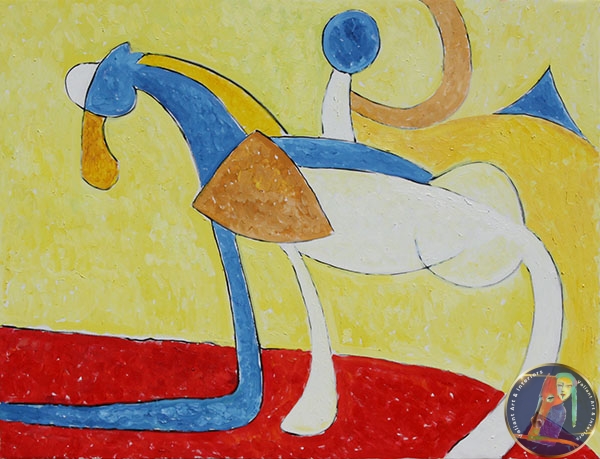
Small Composition 4 is a compelling oil on canvas work by the Mongolian contemporary artist Saikhanbayar Banzardari. Measuring 60 x 80cm, the piece reflects the artist’s signature blend of traditional Mongolian motifs and modern abstract sensibilities.
Visual Description
The painting is a vibrant exploration of movement and texture, characteristic of Banzardari’s style which often bridges the gap between his nomadic heritage and contemporary global art trends.
Subject Matter: While the title suggests an abstract “composition,” the work subtly evokes the energy of the Mongolian steppe. The brushwork is gestural and rhythmic, creating a sense of fluid motion that mimics the wind across open plains or the sweeping gait of a horse—a recurring theme in the artist’s oeuvre.
Color Palette: The artist utilizes a sophisticated palette that balances earthy, grounded tones with sudden bursts of brilliant color. Expect to see deep ochres and siennas contrasted against sharp cerulean or crimson highlights, giving the “Small Composition” a visual weight that feels much larger than its physical dimensions.
Texture and Technique: Utilizing the richness of oil paint, Banzardari employs visible, confident strokes. There is a play between thick impasto layers and thinner, translucent glazes, providing the canvas with a structural depth that invites the viewer to look beyond the surface.
Context and Provenance
Artist Background: Born in 1975 in Erdenet City, Saikhanbayar Banzardari is part of a generation of Mongolian artists who emerged following the country’s transition to democracy, allowing for greater experimental freedom.
Significance: This specific piece is cataloged under the accession number SBR/010. It represents the period of the artist’s career surrounding his international exposure, notably around the time of the 2010 International Equestrian Festival in Lexington, Kentucky.
Cultural Intersection: The painting serves as a bridge between the artist’s roots in Mongolian equestrian culture and the universal language of abstract expressionism. It does not merely depict a scene; it captures the spirit and velocity associated with the Mongolian landscape.