
Single Ger

Khurelbaatar Choindon , 2006 , Oil On Canvas

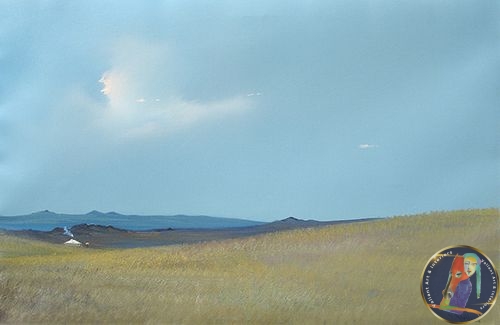
Single Ger is a masterful example of Khurelbaatar Choindon’s signature style, blending the technical precision of Photorealism with the soulful depth of Mongolian Realism. Painted in 2006, this oil on canvas ($40 \times 60 \text{ cm}$) captures a quintessential scene of the Mongolian steppe, emphasizing the solitude and resilience of nomadic life.


Visual Composition and Subject Matter

The painting centers on a solitary Ger (a traditional Mongolian felt dwelling), positioned within a vast, undulating landscape. Choindon utilizes the horizontal $40 \times 60 \text{ cm}$ format to emphasize the immense scale of the Mongolian “Eternal Blue Sky” and the rolling grasslands, making the human habitation appear both sturdy and strikingly isolated.

  • The Ger: Rendered with meticulous detail, the texture of the white felt covers and the tension of the ropes securing the structure reflect Choindon’s training at the Repin Academy of Fine Art. Every crease in the fabric and the subtle weathering of the wooden door frame suggests a lived-in history.

  • The Landscape: The terrain is likely depicted in late autumn or early spring, characterized by a palette of ochre, burnt sienna, and muted golds. The artist uses a shallow depth of field typical of photorealist works, where the foreground grasses are crisp and tactile, while the distant hills soften into atmospheric blues and purples.

  • Light and Shadow: Choindon’s use of light is cinematic. The sun sits low on the horizon, casting long, dramatic shadows that define the curvature of the Ger and the ripples in the earth. This lighting creates a high-contrast environment that brings a three-dimensional, “figurative” quality to the inanimate landscape.


Artistic Style and Technique

Reflecting his education in Ulaanbaatar and St. Petersburg, Choindon bridges the gap between Russian Academic Realism and a uniquely Mongolian sensitivity to nature.

  • Photorealism: The painting avoids stylized abstraction. Instead, it relies on hyper-accurate color temperatures and textures to fool the eye into perceiving a photograph.

  • Atmospheric Perspective: By subtly shifting the saturation of the sky from a deep zenith blue to a hazy horizon, Choindon creates a profound sense of “air” and space, a hallmark of his landscape work.


Cultural Context

As the Vice Chairman of the Union of Mongolian Artists (UMA) at the time of this painting, Choindon’s work serves as a cultural anchor. Single Ger is not merely a landscape; it is a portrait of Mongolian identity. It celebrates the “Nature” and “Landscape” themes he is renowned for, portraying the Ger not as a relic, but as a dignified, singular protagonist against the backdrop of the infinite steppe.

Note on the Artist: Khurelbaatar Choindon’s international exhibition history—spanning from the Fukuoka Art Museum to galleries in Washington and Prague—highlights his role as a premier ambassador of Mongolian contemporary realism. His ability to capture the “spirit of place” is what distinguishes Single Ger as a significant work in his 21st-century portfolio.
  • Khurelbaatar Choindon
  • Nature, Realism
  • Oil On Canvas
  • KBR31/014
  • 40 x 60cm
  • Mongolian Art Gallery

Add Your Comment

Mongolian Art Gallery © 2025. All Rights Reserved
Privacy Policy / Terms of Use

Single Ger is a masterful example of Khurelbaatar Choindon’s signature style, blending the technical precision of Photorealism with the soulful depth of Mongolian Realism. Painted in 2006, this oil on canvas ($40 \times 60 \text{ cm}$) captures a quintessential scene of the Mongolian steppe, emphasizing the solitude and resilience of nomadic life.


Visual Composition and Subject Matter

The painting centers on a solitary Ger (a traditional Mongolian felt dwelling), positioned within a vast, undulating landscape. Choindon utilizes the horizontal $40 \times 60 \text{ cm}$ format to emphasize the immense scale of the Mongolian “Eternal Blue Sky” and the rolling grasslands, making the human habitation appear both sturdy and strikingly isolated.

  • The Ger: Rendered with meticulous detail, the texture of the white felt covers and the tension of the ropes securing the structure reflect Choindon’s training at the Repin Academy of Fine Art. Every crease in the fabric and the subtle weathering of the wooden door frame suggests a lived-in history.

  • The Landscape: The terrain is likely depicted in late autumn or early spring, characterized by a palette of ochre, burnt sienna, and muted golds. The artist uses a shallow depth of field typical of photorealist works, where the foreground grasses are crisp and tactile, while the distant hills soften into atmospheric blues and purples.

  • Light and Shadow: Choindon’s use of light is cinematic. The sun sits low on the horizon, casting long, dramatic shadows that define the curvature of the Ger and the ripples in the earth. This lighting creates a high-contrast environment that brings a three-dimensional, “figurative” quality to the inanimate landscape.


Artistic Style and Technique

Reflecting his education in Ulaanbaatar and St. Petersburg, Choindon bridges the gap between Russian Academic Realism and a uniquely Mongolian sensitivity to nature.

  • Photorealism: The painting avoids stylized abstraction. Instead, it relies on hyper-accurate color temperatures and textures to fool the eye into perceiving a photograph.

  • Atmospheric Perspective: By subtly shifting the saturation of the sky from a deep zenith blue to a hazy horizon, Choindon creates a profound sense of “air” and space, a hallmark of his landscape work.


Cultural Context

As the Vice Chairman of the Union of Mongolian Artists (UMA) at the time of this painting, Choindon’s work serves as a cultural anchor. Single Ger is not merely a landscape; it is a portrait of Mongolian identity. It celebrates the “Nature” and “Landscape” themes he is renowned for, portraying the Ger not as a relic, but as a dignified, singular protagonist against the backdrop of the infinite steppe.

Note on the Artist: Khurelbaatar Choindon’s international exhibition history—spanning from the Fukuoka Art Museum to galleries in Washington and Prague—highlights his role as a premier ambassador of Mongolian contemporary realism. His ability to capture the “spirit of place” is what distinguishes Single Ger as a significant work in his 21st-century portfolio.