
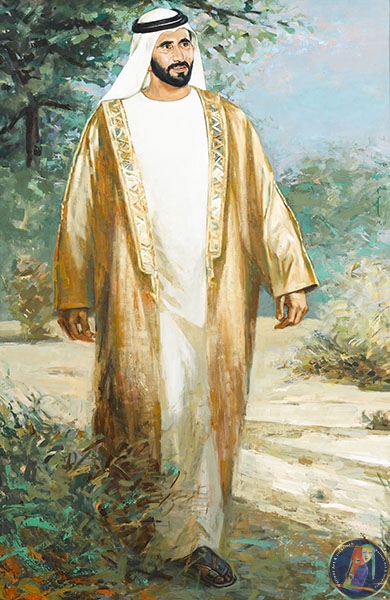
Sheik

Orkhon Namhaidagva , 2005 , Oil On Canvas

Created by the renowned Mongolian artist Orkhon Namhaidagva, Sheik is a masterful execution of contemporary Photorealism and Realism. This large-scale oil on canvas, measuring 150 x 100cm, serves as a profound exploration of character, culture, and the technical limits of oil paint.

Visual Composition and Subject

The painting features a singular, commanding portrait of a man identified as a Sheik. Namhaidagva utilizes the vertical orientation of the canvas to emphasize the subject’s dignified stature. The composition is tightly focused, drawing the viewer into an intimate encounter with the sitter.

  • The Face: The central focus is the subject’s weathered yet noble countenance. Every wrinkle, pore, and follicle is rendered with microscopic precision, characteristic of Namhaidagva’s photorealistic style.

  • The Gaze: The subject’s eyes are captured with a startling clarity, reflecting a sense of wisdom, authority, and a hint of weariness that suggests a long, lived history.

Texture and Technique

Namhaidagva’s background in Bulgan and his mastery of the medium are evident in the hyper-realistic textures throughout the piece:

  • Textiles: The traditional headdress and robes are not merely painted; they are “constructed” through light and shadow. The viewer can almost feel the weight of the fabric and the specific weave of the threads.

  • Chiaroscuro: The artist employs a sophisticated use of light, often emerging from a single directional source. This creates deep, velvety shadows that give the figure a three-dimensional, sculptural quality, making the subject appear as if he is about to step out of the canvas.

Cultural Resonance

While the style is rooted in global Photorealism, the soul of the painting reflects Namhaidagva’s ability to capture human dignity across cultural boundaries. By choosing a subject outside of his native Mongolian landscape, he demonstrates a universalist approach to Portraiture, focusing on the “monumentalism” of the individual.
  • Orkhon Namhaidagva
  • Minimalist, Sculpture, Still Life
  • Oil On Canvas
  • ORD/001
  • 150 x 100cm
  • Mongolian Art Gallery

Add Your Comment

Mongolian Art Gallery © 2025. All Rights Reserved
Privacy Policy / Terms of Use

Created by the renowned Mongolian artist Orkhon Namhaidagva, Sheik is a masterful execution of contemporary Photorealism and Realism. This large-scale oil on canvas, measuring 150 x 100cm, serves as a profound exploration of character, culture, and the technical limits of oil paint.

Visual Composition and Subject

The painting features a singular, commanding portrait of a man identified as a Sheik. Namhaidagva utilizes the vertical orientation of the canvas to emphasize the subject’s dignified stature. The composition is tightly focused, drawing the viewer into an intimate encounter with the sitter.

  • The Face: The central focus is the subject’s weathered yet noble countenance. Every wrinkle, pore, and follicle is rendered with microscopic precision, characteristic of Namhaidagva’s photorealistic style.

  • The Gaze: The subject’s eyes are captured with a startling clarity, reflecting a sense of wisdom, authority, and a hint of weariness that suggests a long, lived history.

Texture and Technique

Namhaidagva’s background in Bulgan and his mastery of the medium are evident in the hyper-realistic textures throughout the piece:

  • Textiles: The traditional headdress and robes are not merely painted; they are “constructed” through light and shadow. The viewer can almost feel the weight of the fabric and the specific weave of the threads.

  • Chiaroscuro: The artist employs a sophisticated use of light, often emerging from a single directional source. This creates deep, velvety shadows that give the figure a three-dimensional, sculptural quality, making the subject appear as if he is about to step out of the canvas.

Cultural Resonance

While the style is rooted in global Photorealism, the soul of the painting reflects Namhaidagva’s ability to capture human dignity across cultural boundaries. By choosing a subject outside of his native Mongolian landscape, he demonstrates a universalist approach to Portraiture, focusing on the “monumentalism” of the individual.