
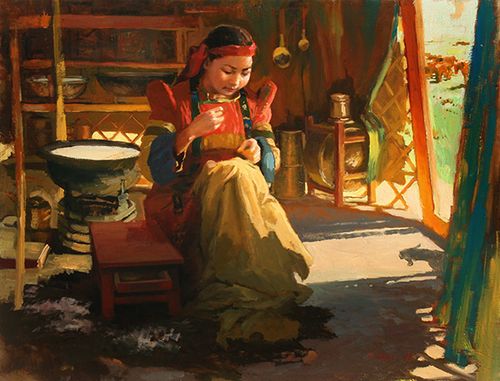
Sew

Batjargal Tseintsogzol , 2009 , Oil On Canvas

Sew (2009) is a compelling example of contemporary Mongolian realism, showcasing Batjargal Tseintsogzol’s mastery of light, texture, and cultural narrative. Measuring $65 \times 81\text{cm}$, this oil-on-canvas work sits at the intersection of Photorealism and traditional nomadic life, capturing a quiet, intimate moment that feels both timeless and deeply specific.

Composition and Subject Matter

The painting depicts an elderly Mongolian woman engaged in the meticulous task of sewing. Tseintsogzol utilizes a tight, focused composition that draws the viewer into the subject’s immediate personal space.

  • The Subject: The woman is portrayed with profound dignity. Her weathered hands—the focal point of the piece—move with the practiced grace of a lifetime of labor. Every wrinkle, age spot, and vein is rendered with such precision that the painting transcends mere representation, becoming a tribute to the resilience of the Mongolian spirit.

  • The Task: The act of “sewing” serves as a metaphor for the preservation of culture. Whether she is mending a deel (traditional garment) or stitching felt for a ger, the rhythmic nature of her work suggests a meditative state, bridging the gap between the domestic and the divine.

Style and Technique

Tseintsogzol’s background in Photorealism is evident in the technical execution of the work:

  • Chiaroscuro Effects: The artist employs a dramatic play of light and shadow. A soft, directional light source (likely from a ger’s door or roof opening) illuminates the woman’s hands and the fabric, while the background recedes into warm, earthy shadows. This creates a “spotlight” effect that emphasizes the importance of the handicraft.

  • Texture and Detail: The tactile quality of the materials is remarkable. You can almost feel the coarseness of the thread, the heavy weight of the textile, and the papery texture of the woman’s skin.

  • Color Palette: The palette is dominated by warm neutrals—ochres, deep browns, and muted reds—reflecting the natural landscape of Mongolia and the organic dyes used in traditional crafts.

Cultural Significance

As an artist born in Ulaanbaatar, Tseintsogzol’s work often serves as a bridge between Mongolia’s nomadic heritage and the modern world. Sew is not just a portrait; it is an ethnographic document. It captures a disappearing pace of life, emphasizing the value of handmade objects in an era of mass production.

The painting honors the matriarchal figures who serve as the backbone of Mongolian society, weaving together the threads of family, tradition, and survival.
  • Batjargal Tseintsogzol
  • Photorealism, Still Life
  • Oil On Canvas
  • BTJ8/109
  • 65 x 81cm
  • Mongolian Art Gallery

Add Your Comment

Mongolian Art Gallery © 2025. All Rights Reserved
Privacy Policy / Terms of Use

Sew (2009) is a compelling example of contemporary Mongolian realism, showcasing Batjargal Tseintsogzol’s mastery of light, texture, and cultural narrative. Measuring $65 \times 81\text{cm}$, this oil-on-canvas work sits at the intersection of Photorealism and traditional nomadic life, capturing a quiet, intimate moment that feels both timeless and deeply specific.

Composition and Subject Matter

The painting depicts an elderly Mongolian woman engaged in the meticulous task of sewing. Tseintsogzol utilizes a tight, focused composition that draws the viewer into the subject’s immediate personal space.

  • The Subject: The woman is portrayed with profound dignity. Her weathered hands—the focal point of the piece—move with the practiced grace of a lifetime of labor. Every wrinkle, age spot, and vein is rendered with such precision that the painting transcends mere representation, becoming a tribute to the resilience of the Mongolian spirit.

  • The Task: The act of “sewing” serves as a metaphor for the preservation of culture. Whether she is mending a deel (traditional garment) or stitching felt for a ger, the rhythmic nature of her work suggests a meditative state, bridging the gap between the domestic and the divine.

Style and Technique

Tseintsogzol’s background in Photorealism is evident in the technical execution of the work:

  • Chiaroscuro Effects: The artist employs a dramatic play of light and shadow. A soft, directional light source (likely from a ger’s door or roof opening) illuminates the woman’s hands and the fabric, while the background recedes into warm, earthy shadows. This creates a “spotlight” effect that emphasizes the importance of the handicraft.

  • Texture and Detail: The tactile quality of the materials is remarkable. You can almost feel the coarseness of the thread, the heavy weight of the textile, and the papery texture of the woman’s skin.

  • Color Palette: The palette is dominated by warm neutrals—ochres, deep browns, and muted reds—reflecting the natural landscape of Mongolia and the organic dyes used in traditional crafts.

Cultural Significance

As an artist born in Ulaanbaatar, Tseintsogzol’s work often serves as a bridge between Mongolia’s nomadic heritage and the modern world. Sew is not just a portrait; it is an ethnographic document. It captures a disappearing pace of life, emphasizing the value of handmade objects in an era of mass production.

The painting honors the matriarchal figures who serve as the backbone of Mongolian society, weaving together the threads of family, tradition, and survival.