
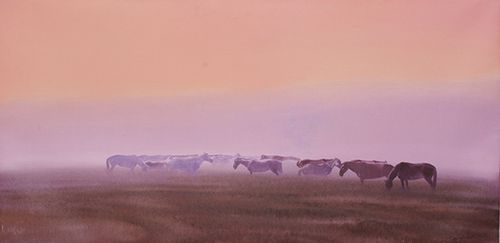
Sad Day

Erdene Dash , 2007 , Oil On Canvas

Sad Day is a poignant masterwork by Mongolian artist Erdene Dash (1966–2009). Executed in oil on canvas with a wide horizontal format (46 x 92 cm), the painting is a profound synthesis of rigorous Russian academic realism and a deeply personal, contemplative connection to the natural world.

Composition and Subject Matter

The painting features a nude figure composition set against an expansive, atmospheric landscape. Dash utilizes his extensive training from the Repin Academy of Arts to render the human form with anatomical precision and a soft, tactile realism. The figure is not merely a subject but appears as an organic extension of the earth itself, positioned within a landscape that suggests the vast, quiet solitudes of the Mongolian steppe or a universal wilderness.

Style and Technique

Dash employs Realism not just as a technical choice, but as a vehicle for emotional depth.

  • Figurative Art: The treatment of the nude body is characterized by a vulnerability that mirrors the title. The flesh tones are layered with subtle glazes to capture the play of natural light.

  • Landscape Integration: The “Nature-Inspired” elements are rendered with a somber palette. The horizon line and the weight of the sky contribute to a sense of melancholic stillness.

  • Atmospheric Perspective: There is a seamless transition between the figure and the background, achieved through soft edges and a harmonious color temperature that evokes a specific, somber moment in time.

Themes and Emotional Resonance

True to its title, Sad Day explores themes of solitude, introspection, and the ephemeral nature of existence. The wide aspect ratio emphasizes a sense of isolation, placing the figure in a vast environment that underscores human fragility. The artwork serves as a testament to Dash’s ability to blend the monumental scale of nature with the intimate, quiet sorrow of the human experience.

  • Erdene Dash
  • Mongolian Style, Photorealism, Sculpture
  • Oil On Canvas
  • ERE24/053
  • 46 x 92cm
  • Mongolian Art Gallery

Add Your Comment

Mongolian Art Gallery © 2025. All Rights Reserved
Privacy Policy / Terms of Use

Sad Day is a poignant masterwork by Mongolian artist Erdene Dash (1966–2009). Executed in oil on canvas with a wide horizontal format (46 x 92 cm), the painting is a profound synthesis of rigorous Russian academic realism and a deeply personal, contemplative connection to the natural world.

Composition and Subject Matter

The painting features a nude figure composition set against an expansive, atmospheric landscape. Dash utilizes his extensive training from the Repin Academy of Arts to render the human form with anatomical precision and a soft, tactile realism. The figure is not merely a subject but appears as an organic extension of the earth itself, positioned within a landscape that suggests the vast, quiet solitudes of the Mongolian steppe or a universal wilderness.

Style and Technique

Dash employs Realism not just as a technical choice, but as a vehicle for emotional depth.

  • Figurative Art: The treatment of the nude body is characterized by a vulnerability that mirrors the title. The flesh tones are layered with subtle glazes to capture the play of natural light.

  • Landscape Integration: The “Nature-Inspired” elements are rendered with a somber palette. The horizon line and the weight of the sky contribute to a sense of melancholic stillness.

  • Atmospheric Perspective: There is a seamless transition between the figure and the background, achieved through soft edges and a harmonious color temperature that evokes a specific, somber moment in time.

Themes and Emotional Resonance

True to its title, Sad Day explores themes of solitude, introspection, and the ephemeral nature of existence. The wide aspect ratio emphasizes a sense of isolation, placing the figure in a vast environment that underscores human fragility. The artwork serves as a testament to Dash’s ability to blend the monumental scale of nature with the intimate, quiet sorrow of the human experience.