Run

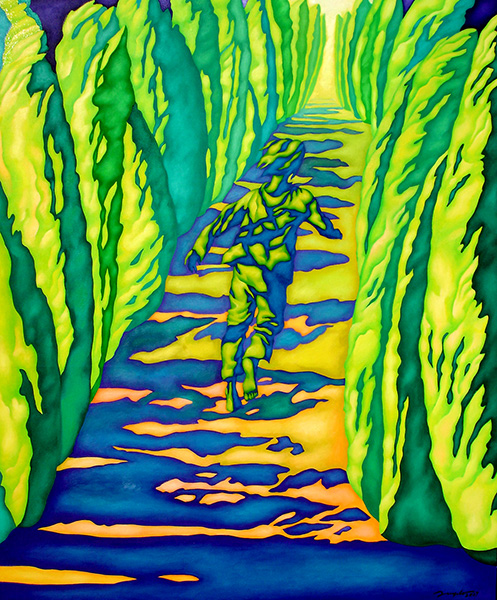
Enkhjargal Tsagaandari , 2007 , Oil On Canvas

Run (2007) is a captivating oil on canvas work by the renowned Mongolian artist Enkhjargal Tsagaandari. Measuring 150 x 120 cm, the painting is a vibrant testament to Tsagaandari’s ability to fuse traditional Mongolian motifs with a bold, contemporary abstract sensibility.

Visual Composition and Style

The painting is characterized by a high-energy, kinetic atmosphere that perfectly mirrors its title. Tsagaandari utilizes a rich palette dominated by earthy ochres, deep ambers, and sudden flashes of cool blues and whites, creating a sense of a vast, shifting landscape.

While the work leans heavily into Abstract Modernism, it remains firmly rooted in the Figurative and Nature-driven traditions of Mongolian art. The “subjects” of the piece—implied to be horses or figures in motion—are not rendered with photographic detail. Instead, they are captured through:

  • Fluid Brushstrokes: Long, sweeping lines that suggest the physical momentum of a gallop.

  • Layered Textures: Thick applications of oil paint that give the canvas a tactile, rugged quality reminiscent of the Mongolian steppe.

  • Blurred Boundaries: The figures seem to dissolve into the background, suggesting that the “run” is not just a physical act, but a spiritual merging with the environment.

Symbolic Context

Given Tsagaandari’s background and birth in Ulaanbaatar, “Run” serves as a bridge between the nomadic heritage of Mongolia and the fast-paced evolution of the modern world. The large scale ($150 \times 120$ cm) allows the viewer to feel enveloped by the movement, transforming the act of running into a metaphor for freedom, survival, and the relentless passage of time.

Artistic Significance

Created during Tsagaandari’s prolific period as a freelance artist (post-2000), this work reflects the maturity of a creator who has moved beyond the formal constraints of his early career at the Union of Mongolian Artists (UMA) and the Military Institute. It showcases the “Contemporary Nature” style for which he is celebrated—where the landscape is not a static backdrop, but a living, breathing force.
  • Enkhjargal Tsagaandari
  • Realism, Still Life
  • Oil On Canvas
  • ENJ25/013
  • 150 x 120cm
  • Mongolian Art Gallery

Add Your Comment

Mongolian Art Gallery © 2025. All Rights Reserved
Privacy Policy / Terms of Use

Run (2007) is a captivating oil on canvas work by the renowned Mongolian artist Enkhjargal Tsagaandari. Measuring 150 x 120 cm, the painting is a vibrant testament to Tsagaandari’s ability to fuse traditional Mongolian motifs with a bold, contemporary abstract sensibility.

Visual Composition and Style

The painting is characterized by a high-energy, kinetic atmosphere that perfectly mirrors its title. Tsagaandari utilizes a rich palette dominated by earthy ochres, deep ambers, and sudden flashes of cool blues and whites, creating a sense of a vast, shifting landscape.

While the work leans heavily into Abstract Modernism, it remains firmly rooted in the Figurative and Nature-driven traditions of Mongolian art. The “subjects” of the piece—implied to be horses or figures in motion—are not rendered with photographic detail. Instead, they are captured through:

  • Fluid Brushstrokes: Long, sweeping lines that suggest the physical momentum of a gallop.

  • Layered Textures: Thick applications of oil paint that give the canvas a tactile, rugged quality reminiscent of the Mongolian steppe.

  • Blurred Boundaries: The figures seem to dissolve into the background, suggesting that the “run” is not just a physical act, but a spiritual merging with the environment.

Symbolic Context

Given Tsagaandari’s background and birth in Ulaanbaatar, “Run” serves as a bridge between the nomadic heritage of Mongolia and the fast-paced evolution of the modern world. The large scale ($150 \times 120$ cm) allows the viewer to feel enveloped by the movement, transforming the act of running into a metaphor for freedom, survival, and the relentless passage of time.

Artistic Significance

Created during Tsagaandari’s prolific period as a freelance artist (post-2000), this work reflects the maturity of a creator who has moved beyond the formal constraints of his early career at the Union of Mongolian Artists (UMA) and the Military Institute. It showcases the “Contemporary Nature” style for which he is celebrated—where the landscape is not a static backdrop, but a living, breathing force.