
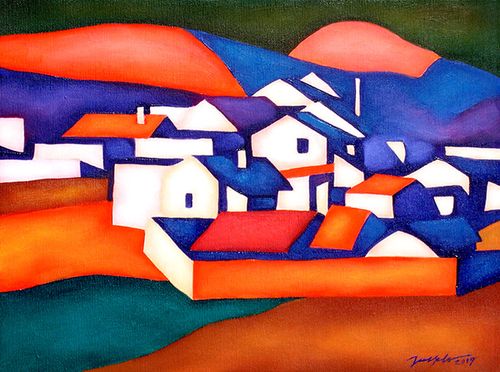
Research 3 is a compelling oil on canvas work that serves as a bridge between Enkhjargal Tsagaandari’s academic background in monumental art and her evolution into a freelance contemporary artist. Measuring 30 x 40cm, the painting utilizes its modest scale to create an intimate, focused exploration of form and atmosphere.
Composition and Style
The painting is a sophisticated blend of Abstract and Figurative styles, a hallmark of Tsagaandari’s post-2000 freelance era. The composition does not rely on a traditional linear perspective; instead, it uses a layered approach to create depth.
The Figurative Elements: Central to the work are forms that suggest organic matter or biological structures, living up to the title “Research.” These shapes are rendered with a precision that hints at her years as a teacher at the College of Fine Art, showing a masterly control over anatomical or botanical suggestion.
The Abstract Atmosphere: Surrounding the central focus is a wash of modern, contemporary textures. The brushwork is expressive yet controlled, moving between thin glazes of oil that allow the canvas grain to peek through and thicker, more opaque applications that provide tactile weight.
Color Palette and Light
Tsagaandari’s roots in Ulaanbaatar and her connection to Nature and Landscape are evident in her color choices.
Tonal Harmony: The palette is dominated by earthy, grounded tones—deep ochres, muted umbers, and perhaps flashes of mineral blues or oxidized greens. These colors evoke the natural Mongolian landscape while remaining firmly in the realm of the “scientific” or “experimental.”
Luminosity: There is a distinct internal glow within the painting. Rather than having a singular external light source, the light seems to emanate from the “research” subject itself, highlighting the artist’s interest in the inner life of her subjects.
Thematic Interpretation
Given Tsagaandari’s experience with Monumental Art and her transition into abstraction, Research 3 feels like a microscopic look at a macroscopic world. It captures a moment of inquiry—an artistic “study” that treats the canvas as a laboratory slide.
The work reflects the quiet, contemplative nature of her 1989 “Spring” exhibition and the international exposure she gained in China and Austria. It represents a mature artist who has moved past the rigid requirements of institutional art (like her time at the Military Institute) into a space of pure, modern exploration where nature and human perception intersect.