Red Woman

Uranchimeg Sodnom , 2006 , Oil On Canvas

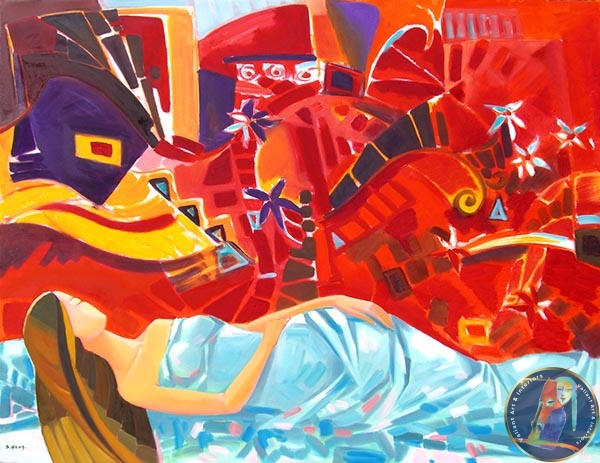
Red Woman is a powerful, large-scale oil painting spanning 100 by 130 centimeters. The artwork balances the rich, illustrative traditions of Mongolian folk art (Mongol Zurag) with a bold, contemporary Western expressive style. The composition is dominated by a central female figure, capturing a profound intersection of traditional nomadic identity and modern female empowerment.

Detailed Description

1. The Central Figure & Subject Matter

The focal point of the canvas is a Mongolian woman depicted from the torso up. Her posture is poised and dignified, carrying an air of quiet resilience that echoes the historical strength of women in nomadic culture.

Her facial features are rendered with clean, elegant lines—reminiscent of traditional book illustrations—yet her expression is deeply psychological. Her eyes gaze directly out at the viewer, holding a look that is both introspective and piercingly direct.

2. The Color Palette & Vestments

True to the painting’s title, the color red commands the canvas.

  • The Deel: The woman is clothed in a stylized, modern adaptation of a traditional deel (the classic Mongolian tunic-robe). The garment is painted in deep crimson and vibrant scarlet tones, applied with thick, confident brushstrokes that give the fabric a heavy, textured presence.

  • Symbolism: In Mongolian culture, red symbolizes joy, vitality, and warmth in a harsh landscape; here, it also serves as a visceral marker of female power and life force.

  • Ornamentation: Accentuated across the collar and cuffs are hints of intricate patterns, suggesting traditional geometric and zoomorphic knotwork, rendered with precise, fine-brush details that highlight the artist’s pedagogical training.

3. Background and Atmosphere

The background moves away from strict realism, dissolving into an atmospheric, semi-abstract space.

  • The Steppe Evoked: Earthy ochres, muted golds, and deep blues swirl around the central figure, subtly evoking the vast, open spaces of the Mongolian steppe and the eternal blue sky (Tenger).

  • Texture: The oil paint is applied with varied techniques—ranging from smooth, thin glazes that make portions of the background look ethereal, to heavy impasto strokes that give the edges of the canvas a rugged, tactile quality. This blending of abstract space ensures the “Red Woman” remains the undisputed, monumental anchor of the piece.

4. Composition and Scale

The horizontal layout (100 x 130 cm) gives the painting a cinematic breadth. By placing the woman prominently within this wide space, the artist creates a deliberate tension between the vastness of the world she inhabits and her own commanding physical and spiritual presence. The lighting is focused primarily on her face and the folds of her red robe, casting soft shadows that give the portrait a sculptural, timeless dimension.
  • Uranchimeg Sodnom
  • Ulaanbaatar, Mongolia
  • Abstract, Expressionist, Figurative, Modern/Contemporary, Still Life
  • Oil on canvas
  • URN52/007
  • 100 x 130cm39" x 51"
  • Valiant Art & Interiors

Add Your Comment

Mongolian Art Gallery © 2025. All Rights Reserved
Privacy Policy / Terms of Use

Red Woman is a powerful, large-scale oil painting spanning 100 by 130 centimeters. The artwork balances the rich, illustrative traditions of Mongolian folk art (Mongol Zurag) with a bold, contemporary Western expressive style. The composition is dominated by a central female figure, capturing a profound intersection of traditional nomadic identity and modern female empowerment.

Detailed Description

1. The Central Figure & Subject Matter

The focal point of the canvas is a Mongolian woman depicted from the torso up. Her posture is poised and dignified, carrying an air of quiet resilience that echoes the historical strength of women in nomadic culture.

Her facial features are rendered with clean, elegant lines—reminiscent of traditional book illustrations—yet her expression is deeply psychological. Her eyes gaze directly out at the viewer, holding a look that is both introspective and piercingly direct.

2. The Color Palette & Vestments

True to the painting’s title, the color red commands the canvas.

  • The Deel: The woman is clothed in a stylized, modern adaptation of a traditional deel (the classic Mongolian tunic-robe). The garment is painted in deep crimson and vibrant scarlet tones, applied with thick, confident brushstrokes that give the fabric a heavy, textured presence.

  • Symbolism: In Mongolian culture, red symbolizes joy, vitality, and warmth in a harsh landscape; here, it also serves as a visceral marker of female power and life force.

  • Ornamentation: Accentuated across the collar and cuffs are hints of intricate patterns, suggesting traditional geometric and zoomorphic knotwork, rendered with precise, fine-brush details that highlight the artist’s pedagogical training.

3. Background and Atmosphere

The background moves away from strict realism, dissolving into an atmospheric, semi-abstract space.

  • The Steppe Evoked: Earthy ochres, muted golds, and deep blues swirl around the central figure, subtly evoking the vast, open spaces of the Mongolian steppe and the eternal blue sky (Tenger).

  • Texture: The oil paint is applied with varied techniques—ranging from smooth, thin glazes that make portions of the background look ethereal, to heavy impasto strokes that give the edges of the canvas a rugged, tactile quality. This blending of abstract space ensures the “Red Woman” remains the undisputed, monumental anchor of the piece.

4. Composition and Scale

The horizontal layout (100 x 130 cm) gives the painting a cinematic breadth. By placing the woman prominently within this wide space, the artist creates a deliberate tension between the vastness of the world she inhabits and her own commanding physical and spiritual presence. The lighting is focused primarily on her face and the folds of her red robe, casting soft shadows that give the portrait a sculptural, timeless dimension.