
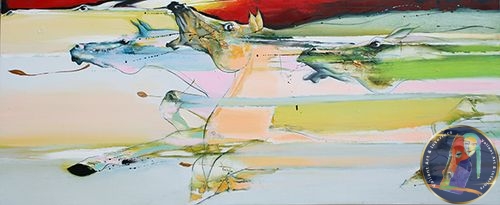
Race 4

Enkhtaivan Ochirbat , 2010 , Oil On Canvas

Enkhtaivan Ochirbat’s Race 4 (2010) is a panoramic oil-on-canvas masterpiece that captures the kinetic energy and spiritual essence of a Mongolian horse race. Spanning a wide 59 x 150 cm format, the painting utilizes its horizontal orientation to emphasize the speed and momentum of the subjects as they streak across the landscape.

Visual Composition and Style

Blending Contemporary Figurative elements with an Expressionist flair, Ochirbat moves away from literal realism to focus on the “feeling” of the race. The composition is characterized by:

  • Sense of Motion: The horses and riders are not rendered with sharp, static lines. Instead, Ochirbat uses blurred edges and elongated strokes to simulate high velocity. The legs of the horses often dissolve into the dust and earth, suggesting a rhythmic, thundering pace.

  • Color Palette: True to his “Abstract Modern” associations, the artist employs a sophisticated palette. While grounded in the earthy tones of the Mongolian steppe—ochres, burnt siennas, and dusty browns—there are often vibrant pops of color in the riders’ tunics (deels), creating a flickering effect as they move through the frame.

  • Texture: The use of oil is tactile and layered. Thick applications of paint (impasto) are likely used to represent the kicked-up dust and the powerful musculature of the horses, giving the flat canvas a three-dimensional, atmospheric quality.

Cultural Context

Reflecting Ochirbat’s roots in Ulaanbaatar and his education at the Art Institute, the painting is a modern tribute to the “Naadam” tradition.

  • The Subjects: The riders are depicted as small, agile figures—a nod to the traditional Mongolian child jockeys—emphasizing the symbiotic relationship between the person and the animal.

  • The Landscape: The background is stripped of unnecessary detail, focusing instead on the vastness of the sky and the horizon. This abstraction highlights the isolation and grit of the race, making the event feel both timeless and immediate.

  • Enkhtaivan Ochirbat
  • Abstract, Expressionist
  • Oil On Canvas
  • ENT21/064
  • 59 x 150
  • Mongolian Art Gallery

Add Your Comment

Mongolian Art Gallery © 2025. All Rights Reserved
Privacy Policy / Terms of Use

Enkhtaivan Ochirbat’s Race 4 (2010) is a panoramic oil-on-canvas masterpiece that captures the kinetic energy and spiritual essence of a Mongolian horse race. Spanning a wide 59 x 150 cm format, the painting utilizes its horizontal orientation to emphasize the speed and momentum of the subjects as they streak across the landscape.

Visual Composition and Style

Blending Contemporary Figurative elements with an Expressionist flair, Ochirbat moves away from literal realism to focus on the “feeling” of the race. The composition is characterized by:

  • Sense of Motion: The horses and riders are not rendered with sharp, static lines. Instead, Ochirbat uses blurred edges and elongated strokes to simulate high velocity. The legs of the horses often dissolve into the dust and earth, suggesting a rhythmic, thundering pace.

  • Color Palette: True to his “Abstract Modern” associations, the artist employs a sophisticated palette. While grounded in the earthy tones of the Mongolian steppe—ochres, burnt siennas, and dusty browns—there are often vibrant pops of color in the riders’ tunics (deels), creating a flickering effect as they move through the frame.

  • Texture: The use of oil is tactile and layered. Thick applications of paint (impasto) are likely used to represent the kicked-up dust and the powerful musculature of the horses, giving the flat canvas a three-dimensional, atmospheric quality.

Cultural Context

Reflecting Ochirbat’s roots in Ulaanbaatar and his education at the Art Institute, the painting is a modern tribute to the “Naadam” tradition.

  • The Subjects: The riders are depicted as small, agile figures—a nod to the traditional Mongolian child jockeys—emphasizing the symbiotic relationship between the person and the animal.

  • The Landscape: The background is stripped of unnecessary detail, focusing instead on the vastness of the sky and the horizon. This abstraction highlights the isolation and grit of the race, making the event feel both timeless and immediate.