
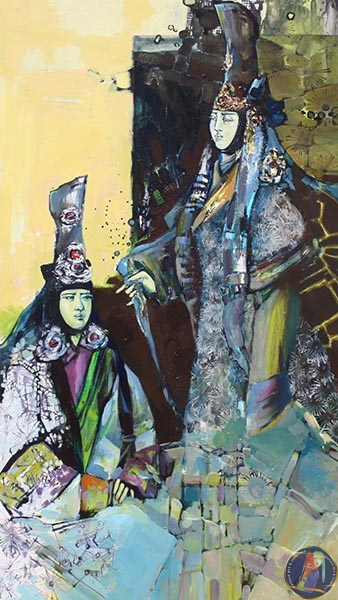
Set against a deep, textured background of rich crimsons and subtle earth tones, Queen Chat (2009) is a compelling synthesis of traditional Mongolian iconography and sleek contemporary abstraction. The composition is vertically oriented, measuring 90 by 50 centimeters, which lends a stately, totem-like presence to the central figures.
The painting depicts two stylized female figures, interpreted as queens, engaged in an intimate, silent dialogue. Their forms are elongated and rendered with a blend of sharp, geometric lines and smooth, fluid curves that evoke the influence of modern cubism while remaining deeply rooted in the flat, graphic sensibilities of Mongol Zurag (traditional Mongolian painting).
The queens are adorned in highly stylized variations of traditional Mongolian attire. Their towering, elaborate headdresses—reminiscent of the historic khalkha bridal coiffure—are flattened into bold architectural shapes, decorated with intricate networks of fine lines and geometric patterns that suggest heavy silverwork, coral, and turquoise without rendering them realistically. The garments flow down in strict, clean panels of contrasting color, shifting from deep blues and emerald greens to accents of muted gold, creating a structural rhythm down the canvas.
Their faces are abstracted into minimalist, elegant masks: elongated eyes indicated by precise, curved lines, high cheekbones emphasized by sharp color blocks, and small, impassive mouths. One queen is positioned slightly in profile, leaning toward the other, who faces forward but casts a stylized glance sideways. The spatial relationship between them is compressed; there is no realistic depth or perspective, forcing the viewer to focus entirely on the negative space between their silhouettes, which crackles with the energy of their unspoken conversation.
Enkhbold’s brushwork balances smooth, opaque color fields within the figures against a highly tactile, layered application of oil paint in the background. The surrounding environment feels ancient and weathered, with visible scrapes and tonal shifts in the dark red pigment, suggesting a timeless, historical space. The overall effect is a powerful visual tension: the ancient dignity and rigid courtly protocol of Mongolia’s nomadic royalty reinterpreted through a crisp, sophisticated, and undeniably 21st-century aesthetic lens.