Queen 2

Undram Enkhbold , 2009 , Oil On Canvas

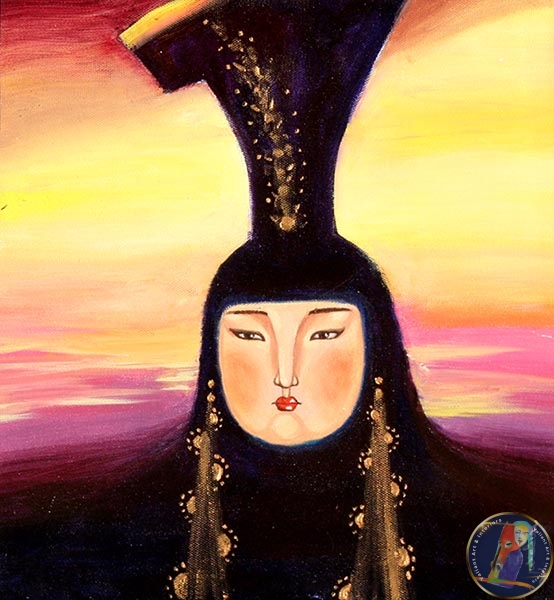
The painting is a compact, vertical portrait ($30 \times 26\text{ cm}$) focusing on a single female figure—a Mongolian queen—rendered in a style that seamlessly bridges traditional Mongolian iconography with modern contemporary aesthetics.

The queen is positioned centrally in a stylized, close-up portrait format. Rather than a purely realistic depiction, her form is interpretive and elegant, emphasizing the iconic silhouette of historical Mongolian royalty. Her face is serene and minimalist, with clean lines defining her features, reflecting a modern graphic sensibility while maintaining a timeless, regal poise.

Attire and Headpiece

The focal point of the artwork is her elaborate, traditional Mongolian headpiece (shashir or khantshir), which is reimagined with a contemporary flair.

  • The Structure: The headpiece frames her face with sweeping, architectural wings that recall the traditional horn-like hair structures (khalkha) worn by noblewomen. However, Enkhbold uses modern abstraction to simplify these large, dramatic shapes into sleek, sweeping curves.

  • Ornamentation: Detailed textures within the oil paint suggest intricate silver work, coral, and turquoise embellishments typical of Mongolian bridal and royal regalia. Delicate, vertical long tassels hang down the sides of her face, cutting clean lines against her garments.

  • The Robe (Deel): Below the headpiece, the high, structured collar of her royal deel (traditional robe) is visible. The fabric is treated with a mixture of broad, confident brushstrokes and delicate pattern work, hinting at heavy silks or brocades without becoming bogged down in hyper-realistic detail.

Color Palette and Texture

The color palette balances rich, deeply rooted traditional tones with modern, expressive choices.

  • Dominant Tones: Deep crimson reds, imperial blues, and burnt oranges dominate the figure’s attire, honoring the vibrant colors historically associated with Mongolian nobility.

  • Background and Contrast: The background is relatively flat or subtly textured, utilizing a more muted, contemporary palette—perhaps earth tones or neutral grays—which pushes the intensely colored subject straight to the foreground.

  • Texture: The oil medium is applied with varying density. In some areas, the paint is smooth and precise, emphasizing the sharp lines of the queen’s profile and jewelry. In other sections, visible, expressive brushstrokes bring a lively, modern energy to the canvas, preventing the piece from feeling stagnant or purely historical.

Overall Mood and Style

Queen 2 strikes a powerful balance between reverence and innovation. By stripping away hyper-detailed realism in favor of bold forms and symbolic color choices, Enkhbold captures the psychological weight and enduring dignity of the Mongolian queen. It is a piece where the weight of nomadic history meets the clean, graphic execution of 21st-century contemporary art.
  • Undram Enkhbold
  • Ulaanbaatar, Mongolia
  • Modern/Contemporary, Mongolian Style
  • Oil on canvas
  • UND/005
  • 30 x 26 cm11" x 10"
  • Valiant Art & Interiors

Add Your Comment

Mongolian Art Gallery © 2025. All Rights Reserved
Privacy Policy / Terms of Use

The painting is a compact, vertical portrait ($30 \times 26\text{ cm}$) focusing on a single female figure—a Mongolian queen—rendered in a style that seamlessly bridges traditional Mongolian iconography with modern contemporary aesthetics.

The queen is positioned centrally in a stylized, close-up portrait format. Rather than a purely realistic depiction, her form is interpretive and elegant, emphasizing the iconic silhouette of historical Mongolian royalty. Her face is serene and minimalist, with clean lines defining her features, reflecting a modern graphic sensibility while maintaining a timeless, regal poise.

Attire and Headpiece

The focal point of the artwork is her elaborate, traditional Mongolian headpiece (shashir or khantshir), which is reimagined with a contemporary flair.

  • The Structure: The headpiece frames her face with sweeping, architectural wings that recall the traditional horn-like hair structures (khalkha) worn by noblewomen. However, Enkhbold uses modern abstraction to simplify these large, dramatic shapes into sleek, sweeping curves.

  • Ornamentation: Detailed textures within the oil paint suggest intricate silver work, coral, and turquoise embellishments typical of Mongolian bridal and royal regalia. Delicate, vertical long tassels hang down the sides of her face, cutting clean lines against her garments.

  • The Robe (Deel): Below the headpiece, the high, structured collar of her royal deel (traditional robe) is visible. The fabric is treated with a mixture of broad, confident brushstrokes and delicate pattern work, hinting at heavy silks or brocades without becoming bogged down in hyper-realistic detail.

Color Palette and Texture

The color palette balances rich, deeply rooted traditional tones with modern, expressive choices.

  • Dominant Tones: Deep crimson reds, imperial blues, and burnt oranges dominate the figure’s attire, honoring the vibrant colors historically associated with Mongolian nobility.

  • Background and Contrast: The background is relatively flat or subtly textured, utilizing a more muted, contemporary palette—perhaps earth tones or neutral grays—which pushes the intensely colored subject straight to the foreground.

  • Texture: The oil medium is applied with varying density. In some areas, the paint is smooth and precise, emphasizing the sharp lines of the queen’s profile and jewelry. In other sections, visible, expressive brushstrokes bring a lively, modern energy to the canvas, preventing the piece from feeling stagnant or purely historical.

Overall Mood and Style

Queen 2 strikes a powerful balance between reverence and innovation. By stripping away hyper-detailed realism in favor of bold forms and symbolic color choices, Enkhbold captures the psychological weight and enduring dignity of the Mongolian queen. It is a piece where the weight of nomadic history meets the clean, graphic execution of 21st-century contemporary art.