
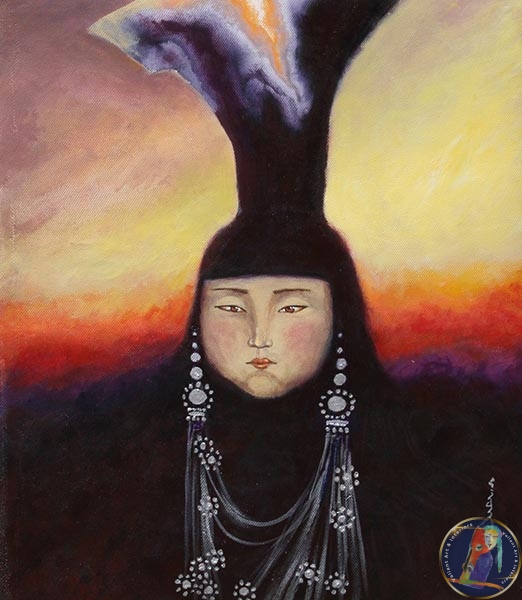
Queen

Undram Enkhbold , 2009 , Oil On Canvas

Queen (2009) is an intimate, evocative portrait by contemporary Mongolian artist Undram Enkhbold that masterfully bridges centuries-old nomadic traditions with twentieth-first-century modern abstraction. Measuring 30 by 26 inches, the composition focuses tightly on the stylized visage and monumental headdress of a regal female figure, embodying the historical grandeur of a Mongol Khatun (Queen) reinterpreted through a distinctly contemporary visual language.

Subject and Composition

The painting features a centralized, close-up depiction of a queen, captured from the chest up. Her face is highly stylized—rendered with minimalist, elegant lines that lean into abstraction rather than strict realism. Her expression is serene, enigmatic, and imbued with quiet authority, characterized by elongated, narrow eyes and a subtle, composed mouth.

The true focal point of the composition is her elaborate, sweeping headdress, modeled after the traditional, wing-like khalkh coiffure historically worn by noble Mongol women. This towering structure dominates the upper two-thirds of the canvas, its dramatic curves extending toward the edges of the frame to create a powerful sense of visual weight and presence.

Style and Technique

Enkhbold seamlessly fuses the flat, decorative elements of traditional Mongol Zurag painting with Western modernism and contemporary abstraction. Rather than meticulously detailing the individual silver ornaments, corals, and seed pearls typical of a historical dowry headdress, the artist captures their essence through rich texture and expressive brushwork.

The application of oil paint alternates between areas of smooth, deliberate blending on the figure’s face and heavy, impasto strokes across the garments and ornamentation. These thick, layered passages give the artwork a tactile, sculptural quality, allowing light to catch the ridges of the paint and simulate the heavy textures of traditional felt, brocade, and metalwork.

Palette and Atmosphere

The color palette is sophisticated, moody, and deeply rooted in the natural landscapes of the Mongolian steppe. The background is a masterclass in atmospheric abstraction, composed of mottled, earthy tones—deep umbers, muted ochres, and charcoal grays—that seem to shift and dissolve into a haze, reminiscent of campfire smoke or a misty steppe twilight.

Against this dark, atmospheric backdrop, the queen herself emerges in rich, saturated hues. Deep crimson, burnt sienna, and hints of tarnished gold dominate her attire, evoking a sense of ancient, weathered royalty. The stark, minimalist rendering of her skin provides a luminous contrast to the dense, heavy textures surrounding her, drawing the viewer’s eye directly to her piercing, calm gaze.

Interpretation

Created in 2009, Queen stands as a poignant exploration of cultural identity in post-socialist Mongolia. By stripping away the rigid formulas of both traditional realism and Soviet-era academic art, Enkhbold uses a modern aesthetic to reconnect with indigenous nomadic majesty. The painting acts as a bridge across time, transforming a historical symbol of female power into a timeless, hauntingly beautiful icon of contemporary Mongolian art.
  • Undram Enkhbold
  • Ulaanbaatar, Mongolia
  • Modern/Contemporary, Mongolian Style
  • Oil on canvas
  • UND/002
  • 30 x 2611" x 10"
  • Valiant Art & Interiors

Add Your Comment

Mongolian Art Gallery © 2025. All Rights Reserved
Privacy Policy / Terms of Use

Queen (2009) is an intimate, evocative portrait by contemporary Mongolian artist Undram Enkhbold that masterfully bridges centuries-old nomadic traditions with twentieth-first-century modern abstraction. Measuring 30 by 26 inches, the composition focuses tightly on the stylized visage and monumental headdress of a regal female figure, embodying the historical grandeur of a Mongol Khatun (Queen) reinterpreted through a distinctly contemporary visual language.

Subject and Composition

The painting features a centralized, close-up depiction of a queen, captured from the chest up. Her face is highly stylized—rendered with minimalist, elegant lines that lean into abstraction rather than strict realism. Her expression is serene, enigmatic, and imbued with quiet authority, characterized by elongated, narrow eyes and a subtle, composed mouth.

The true focal point of the composition is her elaborate, sweeping headdress, modeled after the traditional, wing-like khalkh coiffure historically worn by noble Mongol women. This towering structure dominates the upper two-thirds of the canvas, its dramatic curves extending toward the edges of the frame to create a powerful sense of visual weight and presence.

Style and Technique

Enkhbold seamlessly fuses the flat, decorative elements of traditional Mongol Zurag painting with Western modernism and contemporary abstraction. Rather than meticulously detailing the individual silver ornaments, corals, and seed pearls typical of a historical dowry headdress, the artist captures their essence through rich texture and expressive brushwork.

The application of oil paint alternates between areas of smooth, deliberate blending on the figure’s face and heavy, impasto strokes across the garments and ornamentation. These thick, layered passages give the artwork a tactile, sculptural quality, allowing light to catch the ridges of the paint and simulate the heavy textures of traditional felt, brocade, and metalwork.

Palette and Atmosphere

The color palette is sophisticated, moody, and deeply rooted in the natural landscapes of the Mongolian steppe. The background is a masterclass in atmospheric abstraction, composed of mottled, earthy tones—deep umbers, muted ochres, and charcoal grays—that seem to shift and dissolve into a haze, reminiscent of campfire smoke or a misty steppe twilight.

Against this dark, atmospheric backdrop, the queen herself emerges in rich, saturated hues. Deep crimson, burnt sienna, and hints of tarnished gold dominate her attire, evoking a sense of ancient, weathered royalty. The stark, minimalist rendering of her skin provides a luminous contrast to the dense, heavy textures surrounding her, drawing the viewer’s eye directly to her piercing, calm gaze.

Interpretation

Created in 2009, Queen stands as a poignant exploration of cultural identity in post-socialist Mongolia. By stripping away the rigid formulas of both traditional realism and Soviet-era academic art, Enkhbold uses a modern aesthetic to reconnect with indigenous nomadic majesty. The painting acts as a bridge across time, transforming a historical symbol of female power into a timeless, hauntingly beautiful icon of contemporary Mongolian art.