
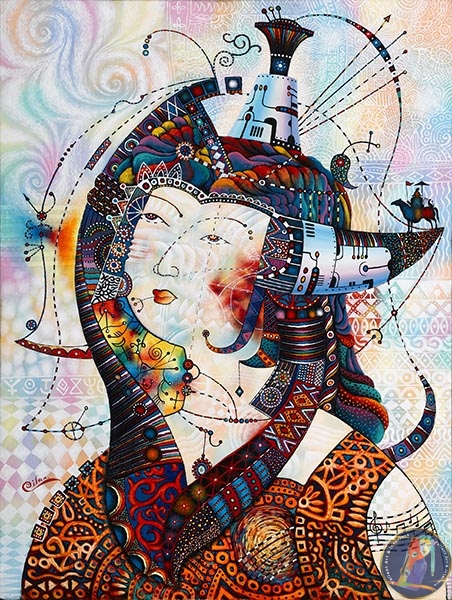
Queen

Oilan Janatkhan , 2006 , Oil On Canvas

Queen is a compelling synthesis of Oilan Janatkhan’s signature Abstract Expressionist energy and his deep roots in Contemporary Mongolian portraiture. Created in 2006, this oil-on-canvas work serves as a psychological study of power and heritage, rendered with the tactile urgency characteristic of his mid-career style.

Composition and Subject

The painting centers on a singular, regal figure that dominates the 80 x 60 cm vertical frame. Janatkhan moves away from literal representation, instead using a Modernist approach to deconstruct the subject’s form. The “Queen” is depicted through a series of bold, structural brushstrokes that suggest traditional Mongolian finery—high collars and ornate headpieces—without being tethered to photorealism.

Color Palette and Texture

True to the Expressionist style, the color palette is both emotive and symbolic:

  • Deep Earth Tones: Siennas and ochres ground the piece, perhaps nodding to the Mongolian landscape.

  • Regal Accents: Splashes of crimson and deep blues suggest the opulence of royalty.

  • Surface Quality: The oil paint is applied with varied density. In some areas, the application is thin and ethereal; in others, heavy impasto creates a physical relief, giving the “Queen” a weathered, timeless presence as if she were emerging from a historical fresco.

Artistic Context

Produced fifteen years after his graduation from the Institute of Fine Art (1991), Queen reflects Janatkhan’s international exposure. Having exhibited across the cultural hubs of Europe—including Paris, Amsterdam, and Bonn—his work in this period bridges the gap between Central Asian nomadic aesthetics and Western European abstraction.

The painting does not just depict a monarch; it captures the essence of sovereignty. Through Janatkhan’s lens, the “Queen” becomes a totem of cultural endurance, characterized by the raw, gestural freedom that defines the 1971-born artist’s contribution to the modern Mongolian art movement.

  • Oilan Janatkhan
  • Calligraphy, Figurative
  • Oil On Canvas
  • OLY46/002
  • 80 x 60cm
  • Mongolian Art Gallery

Add Your Comment

Mongolian Art Gallery © 2025. All Rights Reserved
Privacy Policy / Terms of Use

Queen is a compelling synthesis of Oilan Janatkhan’s signature Abstract Expressionist energy and his deep roots in Contemporary Mongolian portraiture. Created in 2006, this oil-on-canvas work serves as a psychological study of power and heritage, rendered with the tactile urgency characteristic of his mid-career style.

Composition and Subject

The painting centers on a singular, regal figure that dominates the 80 x 60 cm vertical frame. Janatkhan moves away from literal representation, instead using a Modernist approach to deconstruct the subject’s form. The “Queen” is depicted through a series of bold, structural brushstrokes that suggest traditional Mongolian finery—high collars and ornate headpieces—without being tethered to photorealism.

Color Palette and Texture

True to the Expressionist style, the color palette is both emotive and symbolic:

  • Deep Earth Tones: Siennas and ochres ground the piece, perhaps nodding to the Mongolian landscape.

  • Regal Accents: Splashes of crimson and deep blues suggest the opulence of royalty.

  • Surface Quality: The oil paint is applied with varied density. In some areas, the application is thin and ethereal; in others, heavy impasto creates a physical relief, giving the “Queen” a weathered, timeless presence as if she were emerging from a historical fresco.

Artistic Context

Produced fifteen years after his graduation from the Institute of Fine Art (1991), Queen reflects Janatkhan’s international exposure. Having exhibited across the cultural hubs of Europe—including Paris, Amsterdam, and Bonn—his work in this period bridges the gap between Central Asian nomadic aesthetics and Western European abstraction.

The painting does not just depict a monarch; it captures the essence of sovereignty. Through Janatkhan’s lens, the “Queen” becomes a totem of cultural endurance, characterized by the raw, gestural freedom that defines the 1971-born artist’s contribution to the modern Mongolian art movement.