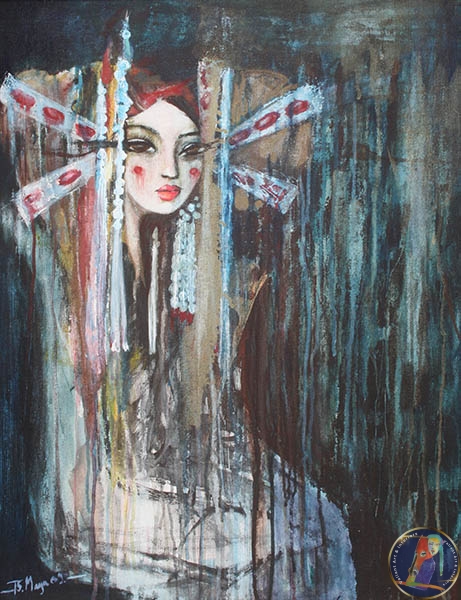
Portrait

Mydagmaa Tserenpil , 2009 , Oil On Canvas

Mydagmaa Tserenpil’s 2009 work, “Portrait,” is a compelling intersection of minimalist restraint and emotional depth. Executed in oil on an 80 x 60cm canvas, the piece reflects the artist’s signature blend of abstract and figurative elements, rooted in her Mongolian heritage but translated through a modern, global lens.

Visual Composition

The painting moves away from traditional realism, leaning heavily into minimalist figurativism. Rather than a detailed anatomical study, Tserenpil utilizes broad, intentional strokes and a simplified palette to suggest the essence of the subject.

  • Form and Silhouette: The subject is rendered with soft, blurred boundaries. By stripping away intricate facial features, Tserenpil focuses on the silhouette and the posture, inviting the viewer to project their own emotions or identity onto the figure.

  • Color Palette: The use of oil allows for a rich, layered texture. The colors often lean toward earthy, muted tones—perhaps a nod to the vast landscapes of her birthplace, Bayankhongor—punctuated by deliberate highlights that create a sense of internal light.

  • Spatial Dynamics: True to her style, the background is treated with an abstract sensibility. There is no defined setting; instead, the subject exists within a “landscape of thought,” where the negative space is as vital to the composition as the figure itself.


Artistic Context

Created when Tserenpil was 25, this piece represents a pivotal moment in her early career, shortly before her work was showcased at the Carrousel Du Louvre in Paris.

  • Cultural Synthesis: While the artist is deeply influenced by the Mongolian environment, “Portrait” demonstrates a departure from literal landscape painting toward an exploration of the human condition.

  • Atmospheric Quality: The oil medium is used to create a “hazy” or “dreamlike” atmosphere. The technique bridges the gap between the physical person and the abstract space they occupy, making the painting feel both intimate and expansive.
  • Mydagmaa Tserenpil
  • Abstract, Portrait, Sculpture
  • Oil On Canvas
  • MYD62/002
  • 80 x 60cm
  • Mongolian Art Gallery

Add Your Comment

Mongolian Art Gallery © 2025. All Rights Reserved
Privacy Policy / Terms of Use

Mydagmaa Tserenpil’s 2009 work, “Portrait,” is a compelling intersection of minimalist restraint and emotional depth. Executed in oil on an 80 x 60cm canvas, the piece reflects the artist’s signature blend of abstract and figurative elements, rooted in her Mongolian heritage but translated through a modern, global lens.

Visual Composition

The painting moves away from traditional realism, leaning heavily into minimalist figurativism. Rather than a detailed anatomical study, Tserenpil utilizes broad, intentional strokes and a simplified palette to suggest the essence of the subject.

  • Form and Silhouette: The subject is rendered with soft, blurred boundaries. By stripping away intricate facial features, Tserenpil focuses on the silhouette and the posture, inviting the viewer to project their own emotions or identity onto the figure.

  • Color Palette: The use of oil allows for a rich, layered texture. The colors often lean toward earthy, muted tones—perhaps a nod to the vast landscapes of her birthplace, Bayankhongor—punctuated by deliberate highlights that create a sense of internal light.

  • Spatial Dynamics: True to her style, the background is treated with an abstract sensibility. There is no defined setting; instead, the subject exists within a “landscape of thought,” where the negative space is as vital to the composition as the figure itself.


Artistic Context

Created when Tserenpil was 25, this piece represents a pivotal moment in her early career, shortly before her work was showcased at the Carrousel Du Louvre in Paris.

  • Cultural Synthesis: While the artist is deeply influenced by the Mongolian environment, “Portrait” demonstrates a departure from literal landscape painting toward an exploration of the human condition.

  • Atmospheric Quality: The oil medium is used to create a “hazy” or “dreamlike” atmosphere. The technique bridges the gap between the physical person and the abstract space they occupy, making the painting feel both intimate and expansive.