
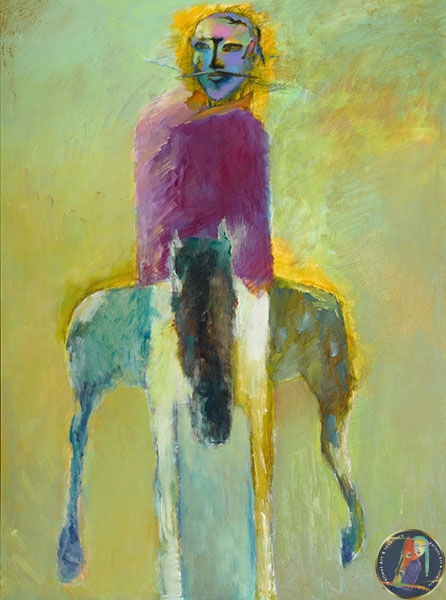
Painting 210 is a compelling testament to Munkhjin Tsultem’s mastery of contemporary figurative art, blending his rigorous academic training from Moscow’s Stroganoff Institute with a distinctly Mongolian soul. Painted in 2006, this large-scale oil on canvas stands at 130 cm by 97 cm, offering a vertical composition that commands the viewer’s attention through its atmospheric depth and emotive brushwork.
Composition and Style
Tsultem utilizes a modern figurative style that leans into the expressive rather than the strictly literal. The painting likely features human forms or symbolic subjects rendered with the sophisticated anatomical understanding gained during his studies in Russia, yet filtered through a lens of nomadic tradition and internal reflection.
Color Palette: Given Tsultem’s body of work, the colors are likely a sophisticated mix of earthy ochres and deep shadows, punctuated by vibrant, symbolic accents. The oil medium is applied with a richness that creates a tactile, layered surface.
Light and Shadow: There is a heavy emphasis on chiaroscuro—a play of light that emerges from a darker, nebulous background to highlight the central figures. This creates a sense of “historical memory,” as if the subjects are manifesting from the vast Mongolian past into the contemporary present.
Thematic Elements
The “210” in the title suggests a series-based approach, focusing on the universal human condition. In this piece, Tsultem explores:
Cultural Identity: The silhouette and posture of the figures often echo the stoicism of the steppe, reflecting the artist’s roots in Ulaanbaatar.
The Bridge of Time: Having lived through Mongolia’s transition from a socialist state to a globalized democracy, Tsultem’s 2006 works often bridge the gap between traditional iconography and modern abstraction.
Context and Significance
Created three decades after his graduation, Painting 210 represents a mature phase of Tsultem’s career. It carries the technical precision of the Russian school but discards rigid realism in favor of a fluid, contemporary energy. The scale of the work (nearly 1.3 meters high) allows the brushstrokes to breathe, making the piece feel less like a static image and more like a captured moment of movement or thought.
Note on Artist Influence: As an artist who has exhibited from Warsaw to Fukuoka, Tsultem’s work in Painting 210 reflects a global dialogue. He remains one of Mongolia’s most influential modernists, using the figurative form to translate the silence of the vast landscape into the language of international contemporary art.