

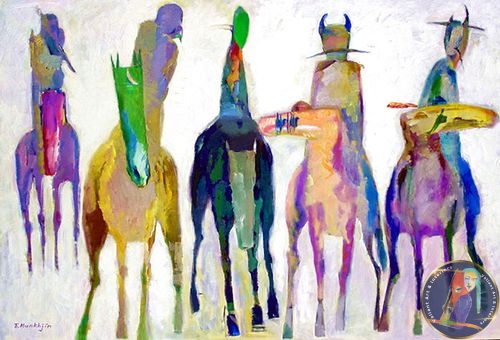
Painting 181 stands as a sophisticated example of Munkhjin Tsultem’s mastery in blending his formal Russian academic training with a uniquely Mongolian contemporary sensibility. Utilizing a generous 112 x 145 cm horizontal canvas, the work occupies a significant physical presence, allowing the artist to explore the intersections of modern figurative art and traditional cultural motifs.
The composition is characterized by a deliberate balance between structured form and expressive texture. Tsultem’s brushwork, refined during his years at the Stroganoff Institute of Art and Design, demonstrates a confident manipulation of oil medium, ranging from smooth, academic renderings to more tactile, modern impasto techniques.
Visual Elements
The Figurative Subject: True to his associated style, the painting centers on the human form or recognizable silhouettes. These figures often possess a monumental quality, reflecting the stoicism and vastness associated with the Mongolian landscape and heritage.
Color Palette: The artist typically employs a palette that bridges the gap between the earthy tones of the Central Asian steppe and the vibrant, symbolic hues of modernism. Expect deep ochres, weathered reds, and expansive blues that suggest both physical space and spiritual depth.
Space and Depth: While the figures are grounded in the figurative tradition, Tsultem often strips away unnecessary environmental detail, leaning toward a contemporary minimalism. This focuses the viewer’s attention on the emotional weight and rhythmic lines of the subjects rather than a literal photographic reality.
Context and Influence
Born in Ulaanbaatar and educated in Moscow, Tsultem’s work in Painting 181 represents a bridge between eras. The “Modern/Contemporary” label is evident in how he deconstructs traditional Mongolian life through a lens of post-Soviet artistic freedom.
The scale of the piece suggests it was intended for a gallery or museum setting, consistent with his history of international exhibitions in art hubs like Fukuoka, Japan and Warsaw, Poland. It is a work that does not merely depict a scene, but rather captures the “essence” of a figure within a modern, globalized context.