
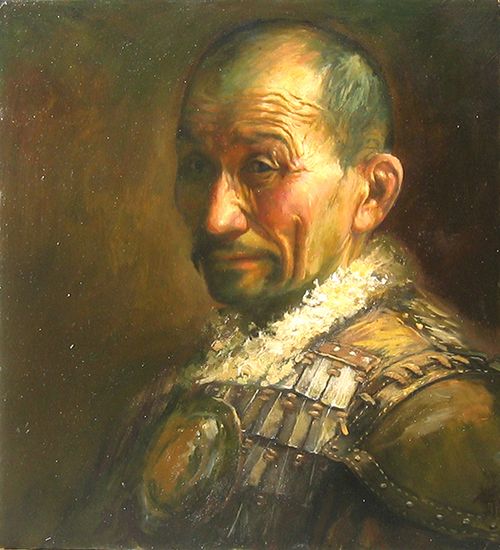
Old Soldier (2005) is a poignant example of Mongolian contemporary realism, captured through the meticulous lens of Batjargal Tseintsogzol. Despite its modest 40 x 40 cm dimensions, the work carries an immense narrative weight, characteristic of Tseintsogzol’s ability to find the profound within the specific.
Visual Composition and Style
Tseintsogzol employs a tight, intimate composition that centers on the weathered face of an aging Mongolian man. Utilizing a Photorealistic approach, the artist does not shy away from the harsh realities of time. Every wrinkle, liver spot, and crease in the subject’s skin is rendered with the precision of a high-resolution photograph, yet softened by the soulful quality only oil on canvas can provide.
Texture: The contrast between the papery, translucent skin of the soldier and the coarse, heavy wool or felt of his traditional Mongolian deel (tunic) is palpable.
Lighting: A soft, directional light source—likely mimicking the natural light of a yurt’s toono (skylight)—casts deep shadows that accentuate the bone structure of the face, emphasizing a life of physical labor and endurance.
The Subject: A Living History
The “Old Soldier” is not depicted in the heat of battle, but in the quietude of his twilight years. His eyes are the focal point; they possess a glassy, reflective quality that suggests he is looking through the viewer rather than at them, perhaps lost in the “nature” of memory.
The title suggests a veteran of Mongolia’s complex 20th-century history. In the lines of his face, one reads the transition of a nation—from the socialist era to a market economy—and the stoicism required to survive both.
The Mongolian Realist Tradition
Tseintsogzol was a master of capturing the Mongolian soul. While the style is Western in its technical execution (Realism/Photorealism), the spirit of the painting is deeply rooted in the Central Asian steppe.
Nature: Though the background is often minimalist or darkened in these portraits, the “nature” referred to in his style is the internal nature of the human spirit and its connection to the rugged Mongolian landscape, which seems to be etched directly into the man’s features.
Legacy of the Artist
Batjargal Tseintsogzol (1966–2020) was a pivotal figure in the Ulaanbaatar art scene. Old Soldier stands as a testament to his dedication to documenting the faces of his people with a dignity that transcends mere documentation, turning a single man into a symbol of a generation’s resilience.