
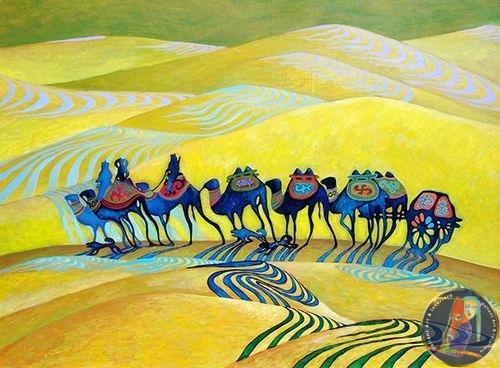
In Nomad 8, Tsegmid Tserennadmid masterfully bridges the gap between Mongolian traditional life and Modern Expressionism. The painting is a vibrant exploration of movement and the vastness of the Central Asian steppe, characterized by the artist’s signature fusion of abstract forms and landscape elements.
Color Palette: The work features a bold, high-contrast palette. Deep earth tones—ochre, burnt sienna, and raw umber—ground the composition, representing the rugged Mongolian terrain. These are punctuated by streaks of cerulean blue and brilliant white, suggesting the shifting sky and the reflective quality of the light at high altitudes.
Brushwork: Tserennadmid employs an Expressionist technique, using thick, energetic impasto. The brushstrokes are directional and rhythmic, creating a sense of constant wind and the nomadic spirit of “becoming” rather than “staying.” The physical texture of the oil paint adds a tactile dimension, echoing the raw, unrefined beauty of the wilderness.
Abstraction vs. Representation: While the title suggests a specific subject, the painting leans heavily into abstraction. Figures or livestock are not rendered with photographic detail; instead, they appear as “ghosts” of motion—suggestive shapes that emerge and dissolve into the horizon line. This reflects the artist’s background in Modernism, prioritizing the emotional resonance of the landscape over literal depiction.
Context and Influence
Painted in 2006, Nomad 8 represents a mature period for Tserennadmid, following his leadership roles at the University of Art & Culture in Ulaanbaatar. The work serves as a psychological map of the Mongolian identity:
The Landscape as Identity: For Tserennadmid, the landscape is not just a setting but a living entity. The 60 x 80 cm frame feels much larger due to the wide-angle perspective, capturing the “eternal blue sky” philosophy central to Mongolian culture.
Cultural Synthesis: The piece reflects the artist’s academic discipline and his lived experience in Ulaanbaatar. It captures the tension between the stationary nature of a canvas and the inherently mobile life of a nomad.
Exhibition History
This particular series gained international recognition shortly after its creation, showcased in major global art hubs. The energy found in Nomad 8 likely contributed to the success of his 2007 tour, which included:
Art Expo Montreal & Las Vegas: Where his contemporary approach to Central Asian themes introduced Western audiences to modern Mongolian aesthetics.
The Arndean Gallery (London): As part of the “Mongolian Kingdom of the Horse” exhibition, highlighting the deep-seated connection between the Mongolian people and their environment.