Nomad 4

Tsegmid Tserennadmid , 2006 , Oil On Canvas

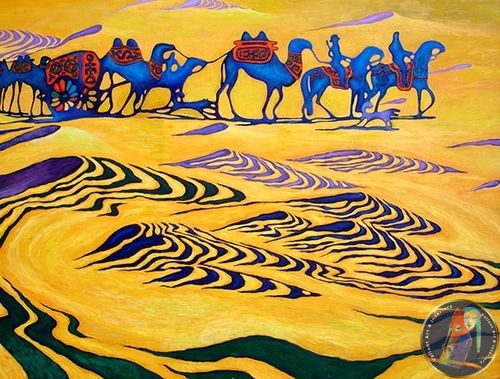
Nomad 4 is a compelling synthesis of Mongolian landscape tradition and contemporary abstraction. Measuring 60 x 80 cm, this oil on canvas work serves as a rhythmic exploration of the vastness and spiritual energy inherent in the Central Asian steppe.

Composition and Color Palette

Tserennadmid employs an expressionist approach, where the physical reality of the landscape is filtered through emotional and stylistic distortion.

  • The Horizon: Unlike traditional landscapes that rely on a static horizon line, Nomad 4 utilizes sweeping, gestural brushstrokes that suggest the rolling contours of the Mongolian terrain.

  • Color Harmony: The palette is a sophisticated blend of earthy ochres, deep ambers, and cooler, atmospheric blues or greys. These colors are not merely descriptive of soil and sky but are applied in layered, textured patches that give the canvas a sense of “breathing” movement.

  • The “Nomadic” Essence: True to its title, the painting avoids concrete architectural anchors. Instead, it captures the fluidity of nomadic life. The forms—perhaps hinting at gers (yurts), livestock, or lone figures—are rendered with blurred edges, suggesting that in the steppe, everything is in a state of transit.


Style and Technique

As an artist born and trained in Ulaanbaatar, Tserennadmid occupies a pivotal space in Mongolian art history. His style in Nomad 4 reflects his transition from formal academic training to a more Modernist/Abstract liberation.

  • Texture: The oil paint is applied with varied density. In some areas, the “scumbled” technique allows underlying layers to peak through, creating a shimmering effect reminiscent of heat haze or the wind-swept dust of the plains.

  • Movement: There is a distinct “musicality” to the work. The brushwork follows a rhythmic cadence, moving the viewer’s eye across the 80cm width of the canvas in a way that mimics the experience of traveling across open space.


Contextual Significance

Created in 2006, just a year before it was likely featured in the artist’s international exhibitions in Montreal, Las Vegas, and London, Nomad 4 represents Tserennadmid at the height of his creative maturity.

“Tserennadmid’s work is a bridge. He takes the ancient, quiet power of the Mongolian landscape and translates it into the energetic, fractured language of the 21st century.”

Having served as the President of the University of Art & Culture in Ulaanbaatar, his technical mastery is evident, but it is his ability to inject Expressionist soul into the vast emptiness of the North that makes Nomad 4 a definitive piece of contemporary Mongolian art. It is less a picture of a place and more a portrait of the feeling of displacement and belonging that defines the nomadic spirit.
  • Tsegmid Tserennadmid
  • Abstract, Modern/Contemporary
  • Oil On Canvas
  • TSG48/004
  • 60 x 80cm
  • Mongolian Art Gallery

Add Your Comment

Mongolian Art Gallery © 2025. All Rights Reserved
Privacy Policy / Terms of Use

Nomad 4 is a compelling synthesis of Mongolian landscape tradition and contemporary abstraction. Measuring 60 x 80 cm, this oil on canvas work serves as a rhythmic exploration of the vastness and spiritual energy inherent in the Central Asian steppe.

Composition and Color Palette

Tserennadmid employs an expressionist approach, where the physical reality of the landscape is filtered through emotional and stylistic distortion.

  • The Horizon: Unlike traditional landscapes that rely on a static horizon line, Nomad 4 utilizes sweeping, gestural brushstrokes that suggest the rolling contours of the Mongolian terrain.

  • Color Harmony: The palette is a sophisticated blend of earthy ochres, deep ambers, and cooler, atmospheric blues or greys. These colors are not merely descriptive of soil and sky but are applied in layered, textured patches that give the canvas a sense of “breathing” movement.

  • The “Nomadic” Essence: True to its title, the painting avoids concrete architectural anchors. Instead, it captures the fluidity of nomadic life. The forms—perhaps hinting at gers (yurts), livestock, or lone figures—are rendered with blurred edges, suggesting that in the steppe, everything is in a state of transit.


Style and Technique

As an artist born and trained in Ulaanbaatar, Tserennadmid occupies a pivotal space in Mongolian art history. His style in Nomad 4 reflects his transition from formal academic training to a more Modernist/Abstract liberation.

  • Texture: The oil paint is applied with varied density. In some areas, the “scumbled” technique allows underlying layers to peak through, creating a shimmering effect reminiscent of heat haze or the wind-swept dust of the plains.

  • Movement: There is a distinct “musicality” to the work. The brushwork follows a rhythmic cadence, moving the viewer’s eye across the 80cm width of the canvas in a way that mimics the experience of traveling across open space.


Contextual Significance

Created in 2006, just a year before it was likely featured in the artist’s international exhibitions in Montreal, Las Vegas, and London, Nomad 4 represents Tserennadmid at the height of his creative maturity.

“Tserennadmid’s work is a bridge. He takes the ancient, quiet power of the Mongolian landscape and translates it into the energetic, fractured language of the 21st century.”

Having served as the President of the University of Art & Culture in Ulaanbaatar, his technical mastery is evident, but it is his ability to inject Expressionist soul into the vast emptiness of the North that makes Nomad 4 a definitive piece of contemporary Mongolian art. It is less a picture of a place and more a portrait of the feeling of displacement and belonging that defines the nomadic spirit.