

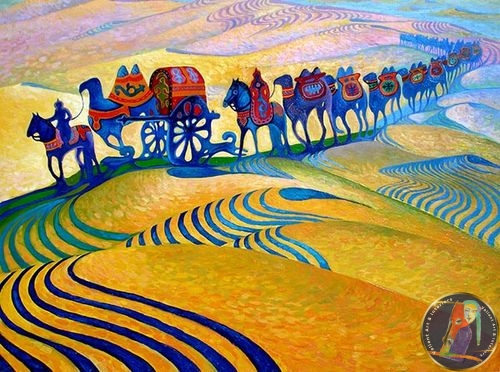
Nomad 2 is a compelling synthesis of Mongolian landscape traditions and modern expressionism. Tsegmid Tserennadmid leverages his deep roots in Ulaanbaatar to transform the vastness of the steppe into a rhythmic, emotive composition.
The painting moves away from literal representation, favoring a semi-abstract approach where the horizon line serves more as a structural anchor than a boundary. Using energetic, layered brushwork characteristic of the contemporary Mongolian school, the artist captures the spirit of nomadic life through movement rather than static imagery.
The color palette likely balances the earthy, grounded tones of the Mongolian plateau—ochres, deep russets, and burnt umbers—with sudden bursts of vibrant color that suggest the “Modern” and “Expressionist” labels associated with his style. The 60 x 80 cm format provides a wide-angle perspective, emphasizing the spatial freedom inherent in the subject matter.
About the Artist: Tsegmid Tserennadmid
Born in 1958 in Ulaanbaatar, Tsegmid is not only a prolific painter but a cornerstone of the Mongolian art establishment. His work is defined by a sophisticated blend of traditional Mongolian aesthetics and global contemporary movements.
Academic & Leadership Background: Tsegmid’s career is marked by high-level institutional leadership, reflecting his influence on the next generation of Mongolian artists:
1985–1989: Teacher at the Fine Art College, Ulaanbaatar.
1989–1995: Director of the Art College in Ulaanbaatar.
1995–1997: President of the University of Art & Culture, Ulaanbaatar.
International Recognition: By the time Nomad 2 was showcased in the late 2000s, Tsegmid had achieved significant international reach, representing the “Mongolian Modern” movement in major global art hubs:
Montreal & Las Vegas (2007): Featured in major Art Expos, bringing Central Asian expressionism to North American audiences.
London (2007): Included in the Mongolian Kingdom of the Horse exhibition at the Arndean Gallery, a pivotal show that highlighted the cultural symbols of his homeland.
Note: Tsegmid’s work is often praised for its “internal rhythm,” where the physical geography of Mongolia is used as a metaphor for the human psyche and the enduring nature of the nomadic spirit.