
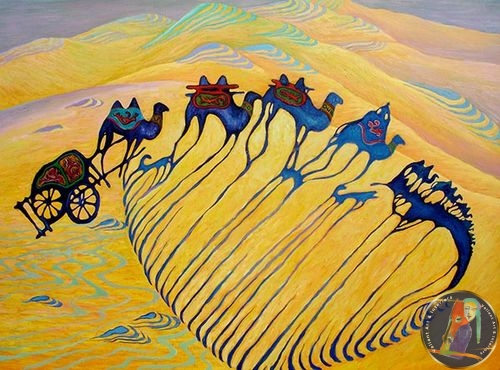
Nomad 10 is a striking synthesis of Mongolian heritage and modern abstraction. The painting captures the essence of the Central Asian steppe, not through literal representation, but through a high-energy, expressionist lens.
Composition and Color: The work is dominated by a rich, earthy palette of deep ochres, burnt sienna, and stark blacks, contrasted against ethereal washes of sky blue and chalky whites. The 60 x 80cm canvas is organized with a horizontal emphasis that evokes the vastness of the Mongolian horizon.
The Central Figure: At the heart of the composition is a stylized, semi-abstracted representation of the nomadic lifestyle. Sweeping, gestural brushstrokes suggest the forms of horses or perhaps the silhouette of a ger (yurt), blending the boundaries between the inhabitants and the land they roam.
Texture and Technique: Tserennadmid utilizes thick, impasto applications of oil paint alongside thinner, translucent glazes. This creates a tactile surface that mirrors the rugged terrain of the artist’s homeland. The movement in the piece is visceral; sharp, calligraphic lines cut through softer fields of color, suggesting the wind and the constant motion inherent to nomadic life.
Artistic Context
Reflecting the artist’s background as a leader in Mongolian art education, Nomad 10 represents a bridge between traditional subjects and contemporary global abstraction.
Style: The piece sits at the intersection of Landscape and Expressionism. It avoids the “tourist-trap” realism often associated with folk art, opting instead for a psychological portrayal of the steppe.
Themes: The “Nomad” series explores the spiritual connection between the Mongolian people and their environment. By 2006, Tserennadmid had refined a visual language that communicates the “spirit of place” rather than just the “sight of place.”
About the Artist: Tsegmid Tserennadmid
Born in 1958 in Ulaanbaatar, Tserennadmid is a seminal figure in the Mongolian modern art movement. His career is marked by a deep commitment to institutional leadership, having served as the President of the University of Art & Culture in Ulaanbaatar.
His work gained significant international traction in the mid-2000s, shortly after Nomad 10 was completed, with high-profile exhibitions in Montreal, Las Vegas, and the Arndean Gallery in London. These exhibitions helped introduce his unique brand of Mongolian Modernism to a Western audience, cementing his reputation as a master of contemporary landscape.